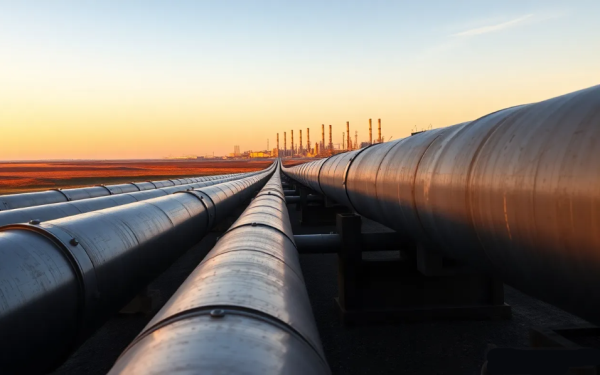
As Canada accelerates its push to diversify energy exports, a proposed new crude oil pipeline connecting Alberta’s oil sands to the northwest coast of British Columbia is drawing early-stage interest from Middle Eastern and Asian investors. Alberta Premier Danielle Smith said Monday that foreign investors could end up holding a “significant” minority stake—anywhere from 15 to 30 percent—if the project moves forward.
“Probably not a majority stake, but at least a substantial stake. Maybe 15 or 30 per cent,” Smith told reporters on the sidelines of the CERAWeek by S&P Global conference in Houston.
Smith confirmed that the Alberta government has been in discussions with Middle Eastern sovereign wealth funds and Asian investors. She added that she expects external capital to emerge more quickly if the federal government designates the pipeline for fast-track approval.
The comments come at a pivotal moment for Canadian energy policy. The United States currently buys nearly 90 percent of Canada’s crude oil exports, but trade tensions and shifting tariff policies under the Trump administration have pushed Ottawa and Alberta—Canada’s largest oil-producing province—to look for alternatives in Asia.
Prime Minister Mark Carney has made diversifying exports a central goal, pledging to double non-U.S. exports over the next decade. A new pipeline to Canada’s west coast is seen as the linchpin of that strategy.
Smith’s remarks also marked the first time the potential role of Middle Eastern and Asian capital in such a project has been publicly acknowledged. Analysts note that Canada, the world’s fourth-largest oil producer, is increasingly viewed by some international investors as a stable alternative amid rising geopolitical turmoil, particularly with ongoing conflict in Iran.
Canada underscored its role in global energy markets last week by releasing 23.6 million barrels of crude oil in coordination with the International Energy Agency.
Still, significant hurdles remain before any investment materializes. Smith said foreign capital will only flow if the federal government provides clear regulatory pathways and a stable carbon pricing framework. Talks between Alberta and Ottawa on industrial carbon pricing were originally expected to conclude by April 1, but that deadline now appears unlikely to be met. Oil sands producers have pushed back against the federal proposal, warning that overly strict emissions rules could make Canadian crude less competitive against U.S. supply.
The project also faces steep opposition on environmental and Indigenous rights grounds. A recent Nanos Research poll commissioned by The Globe and Mail found that 56 percent of Canadians support building a new oil pipeline, and 55 percent back lifting a tanker moratorium along British Columbia’s north coast to make it possible.
But Indigenous leaders in coastal regions have rejected any move to lift the tanker ban, calling it non-negotiable. Green Party leader Elizabeth May dismissed the prospect entirely, saying: “There’s no chance on God’s green Earth that an oil tanker will ever move through the inner waters between Haida Gwaii and the north coast of British Columbia.”
The political landscape shifted last November when the federal and Alberta governments signed a framework agreement to advance pipeline development, with the condition that any new project be privately financed. Smith said Alberta will submit a formal pipeline proposal to the federal government in June. If approved for fast-tracking, she said, a private-sector proponent is more likely to come forward.
So far, no energy company has publicly committed to building the pipeline. Industry observers say the project’s fate will ultimately hinge on whether Canada can strike a workable balance between energy security, climate commitments, and Indigenous rights—and whether Middle Eastern and Asian capital will follow through once policy uncertainties clear up later this year.