
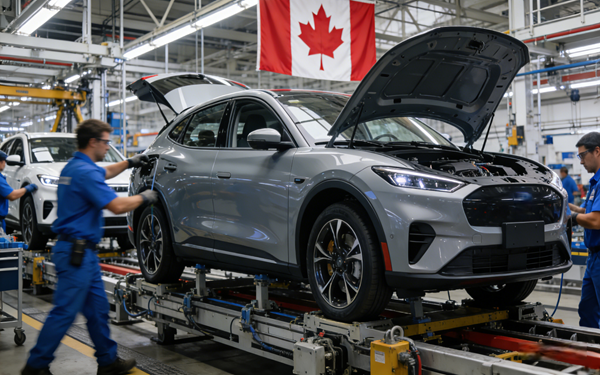
With the U.S. imposing 25% tariffs on non-domestic automotive content, Canada’s auto sector—long deeply integrated into North American supply chains—has been forced to a crossroads. The pillar industry contributes over C$16 billion annually to GDP and supports half a million jobs, yet more than 90% of Canadian-made vehicles and 60% of auto parts are exported to the U.S. The vulnerability of such heavy reliance on a single market has been laid bare by the trade turmoil.
Today, “de-Americanization” is shifting from rhetoric to action. A February survey by KPMG found that 82% of manufacturers are adjusting their supply chain strategies. The path forward is taking shape around three pillars: military contracts, electric vehicles, and cooperation with China.
ITD Industries exemplifies the shift. The manufacturer of container chassis and specialty trailers—hit hard by tariffs on steel, aluminum, and autos—is now pivoting toward defense. “Government contracts for us, we’ve seen a bit of an uptick, and we’re hoping to pivot that business greater into the direction of defense,” CEO Philip Turi said. The company’s mobile command centers, equipped with helipads and capable of supporting drone operations, have already been sold to provincial governments in Ontario and Manitoba.
This move toward dual-use manufacturing is not an isolated case. Dave Power, KPMG’s national sector leader for automotive, noted that even if the Canada-United States-Mexico Agreement (CUSMA) is renegotiated, “going back to where we were before the current trade discomfort with the United States is just not realistic.” Expanding beyond the U.S. market is becoming an industry-wide consensus.
Canada’s new government has unveiled an auto strategy that injects momentum into the transformation. Key measures include allocating C$3 billion from the Strategic Response Fund to support industry adaptation, using tax incentives to encourage zero-emission technology investment, and tightening emissions standards. The revised targets aim for 75% EV sales by 2035 and 90% by 2040, but the previous Electric Vehicle Availability Standard has been repealed, giving automakers flexibility in technology choices in the near term.
On the demand side, the C$2.3 billion EV Affordability Program offers purchase incentives of up to C$5,000. Notably, Canadian-made EVs are exempt from the price cap that applies to vehicles from other countries, creating a policy moat for domestic manufacturing.
Supply chain strength underpins these efforts. Canada is one of the few countries with a fully integrated EV battery supply chain, ranking second in BloombergNEF’s Global Lithium-ion Battery Supply Chain ranking. Volkswagen Group and PowerCo SE are building a “Gigafactory” in St. Thomas, Ontario, expected to be completed in 2027—a project poised to address Canada’s relative weakness in battery manufacturing capacity.
Trade diversification is central to the de-Americanization strategy. Canada currently has 15 free trade agreements covering 51 countries, but its recent moves involving China have drawn particular attention.
Ottawa has struck a strategic partnership with Beijing, allowing 49,000 Chinese-made EVs into the Canadian market at a tariff rate of 6.1%. The intent, however, is not primarily about imports. The arrangement is designed to catalyze joint-venture investment from Chinese automakers into Canada’s automotive manufacturing sector. Separately, Canada signed a memorandum of understanding with South Korea to collaborate on domestic EV manufacturing projects. By drawing in Asian capital and technology, Canada hopes to reshape its industrial landscape in the EV era.
According to the KPMG survey, 40% of companies believe they will emerge stronger from the current disruption. With global EV sales projected to account for nearly 40% of new car sales within five years, Canada’s endowment of critical minerals, battery supply chain expertise, and skilled workforce provides a foundation for transformation. From the unexpected rise of defense-related manufacturing to a systematic push into EVs and strategic cooperation with Asian partners, a more diversified and resilient Canadian automotive industry is beginning to take shape.