Electric Metals (USA) Limited (TSXV: EML; OTCQB: EMUS)
Securing America’s Manganese Supply Chain
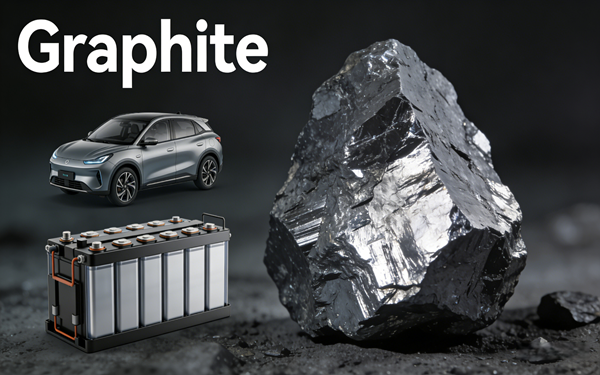
As the global electric vehicle revolution accelerates, every link in the battery supply chain has become a strategic battleground. Canada, endowed with abundant lithium reserves and ambitious battery manufacturing plans, has long faced a critical vulnerability: graphite.
The country holds the world’s tenth-largest graphite reserves, according to Natural Resources Canada. Yet its processing capacity for battery-grade material is virtually non-existent, leaving it heavily dependent on foreign supply chains.
That dependence has become a source of strategic anxiety. China, which controls approximately 90 per cent of global battery-grade graphite refining, has leveraged its dominance not only through aggressive capacity expansion that suppressed global prices—effectively keeping competitors at bay—but also through direct export restrictions on critical minerals. For Western nations racing to secure their green energy futures, the message has been unmistakable.
“We cannot just once again repeat the model that’s been used in the past, where we extract the resource, send it elsewhere to be refined and then purchase it back,” said Julie Paquet, a spokesperson for Nouveau Monde Graphite (NMG), a Quebec-based mineral exploration company at the forefront of Canada’s graphite push.
That model, analysts say, has left Canada exposed at a critical moment.
“Building graphite in our own backyard is a huge strategic advantage, because it helps us maintain sovereignty,” said Max Yerrill, a critical minerals analyst at BMO Capital Markets.
In response, Ottawa is adopting a playbook familiar to observers of China’s industrial policy: generous government subsidies and targeted financial support for domestic producers.
The federal government has been channeling funds through channels such as the Major Projects Office and the Canada Growth Fund (CGF). Last year, NMG’s Matawinie Mine, located 120 kilometres north of Montreal, was designated a priority project under the national critical minerals strategy. The CGF subsequently invested US$25 million in the company as part of a broader financing package.
As policy support and commercial demand converge, a handful of companies are emerging as key players in Canada’s graphite ambitions. Here are four names attracting investor attention.
Focus Graphite Advanced Materials (TSXV:FMS) straddles mining and battery technology, with its flagship Lac Knife project in Quebec—one of North America’s most advanced graphite deposits—achieving technical milestones in 2025 including 99.999% purity levels suitable for nuclear applications, successful use in rocket nozzle components withstanding 3,000°C temperatures, and battery validation confirming near-theoretical electrochemical capacity for lithium-ion cells.
Northern Graphite (TSXV:NGC) operates as one of North America’s few producing graphite miners through its Lac des Iles mine in Ontario, which produced 11,697 tonnes in 2024, and has secured C$6.23 million in government funding to extend operations beyond 2025 while pursuing international expansion through a US$200 million joint venture with Saudi Arabia’s Obeikan Group for a 25,000-tonne annual capacity anode facility in Yanbu.
HydroGraph Clean Power (CSE:HG) takes a technology-focused approach, producing 99.8% pure “fractal graphene” through a proprietary detonation process licensed from Kansas State University, with applications spanning concrete enhancement, battery electrodes, defence coatings, and medical diagnostics—recently upgrading to Tier 1 membership at Manchester University’s Graphene Engineering Innovation Centre to accelerate commercialization.
Titan Mining (TSX:TI) , historically a zinc producer, has gained attention for its Kilbourne graphite project in New York, where a December preliminary economic assessment outlined a 13-year mine life with 37,438 tonnes annual production, US$513 million after-tax NPV, and 37% IRR—the company has commenced production at its demonstration facility, expects first deliveries to defence and industrial customers in early 2026, and secured US$5.5 million in financing from the Export-Import Bank of the United States to advance development.
For Canada, the stakes are clear. Government subsidies, long-term offtake agreements with major automakers, and a new generation of companies advancing both mining and processing capacity are beginning to reshape the North American battery supply chain.
The question now is which players can successfully navigate the transition from resource extraction to full-scale refining—completing the journey from mine to battery. For investors tracking the space, these four companies represent not just exposure to a critical resource, but a bet on the broader realignment of global supply chains in the energy transition.