
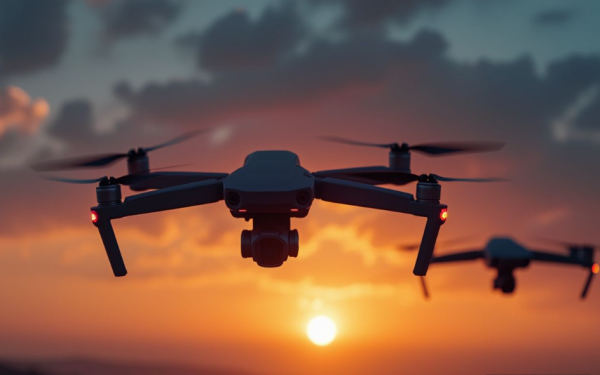
A Ukrainian defense technology company has taken Wall Street by storm this week. Swarmer (SWMR), which specializes in drone swarm control software, listed on the Nasdaq on Tuesday at an IPO price of just $5. In just two trading sessions, the stock has skyrocketed, posting a cumulative gain of nearly 1,100% and cementing its status as a red-hot “meme stock” of the defense sector.
By the close of trading Wednesday, shares had surged 520% from their IPO price, followed by an additional 77% gain, bringing the two-day total return to an eye-popping 1,097%. The explosive performance has locked global investors’ attention onto defense technology—a sector rapidly heating up amid the ongoing Russia-Ukraine conflict and heightened tensions in the Middle East.
Swarmer is not a traditional drone manufacturer. Its core competitive advantage lies in a software platform capable of coordinating the actions of hundreds or even thousands of drones in unison. According to the company, the technology has been deployed on the Ukrainian battlefield since 2023, continuously refined through real-world combat against Russian forces. Swarmer claims its system has completed over 86,000 combat missions, averaging more than 300 per day. Ukrainian Defense Minister Mykhailo Fedorov has publicly praised its capabilities.
In a letter to prospective shareholders, the company’s non-executive chairman, Erik Prince—founder of the infamous private military company Blackwater—emphasized the technology’s battlefield pedigree. “The company’s technology has not only survived combat conditions in Ukraine; it has improved because of them,” Prince wrote. “This distinction matters deeply in an industry where many solutions are conceived for yesterday’s threats or optimized for controlled environments.”
Swarmer’s meteoric rise is not an isolated incident. Geopolitical conflicts have driven demand for low-cost autonomous drones and other military technologies to unprecedented levels, fueling a broad-based rally across the defense technology landscape.
On Friday, the Pentagon awarded privately held defense firm Anduril a massive $20 billion contract, partly aimed at countering unmanned aerial systems. This week, AeroVironment announced it had acquired Empirical Systems Aerospace for approximately $200 million to bolster its drone manufacturing capabilities. Meanwhile, another defense firm, Karman, unveiled plans to open a new facility to produce more components for counter-drone programs and missiles.
Ondas announced on Wednesday a new joint venture with Heidelberger Druckmaschinen to deliver autonomous drone defense and security systems across Germany and Ukraine. “Europe is facing an urgent need to protect critical infrastructure, military installations, and civil assets from evolving drone threats,” Ondas CEO Eric Brock said in a statement.
The market has rewarded these moves handsomely. Ondas stock has surged 49% over the last three months and an astonishing 1,354% over the past 12 months. Karman shares have gained 60% and 179% over the same respective periods, while AeroVironment stock is up 72% over the last year.
However, compared to these more established players, Swarmer’s financial footprint remains minuscule. According to its filing, the Ukrainian firm reported revenue of just $309,920 in 2025, a 6% decline from the previous year. Its net loss widened to $8.5 million, a significant deterioration from the roughly $2.1 million loss recorded in 2024. The company disclosed that “substantially all” of its revenue over the past two years came from a single customer in Ukraine: Smart Machinery Solutions. Looking ahead, Swarmer reported a firm order backlog of $16.3 million over the next 12 to 24 months, with expectations that an additional $16.8 million could be added.
For context, Ondas projects 2025 revenue of as much as $50.7 million, and Karman is expected to report full-year 2025 sales of $469 million next week, according to FactSet estimates.
Analysts point to a shifting investment landscape. Matt Kelly of AlixPartners and MarketWatch’s Emily Bary have noted that defense technology is emerging as a powerful magnet for capital and attention, even as Big Tech pours billions into artificial intelligence, raising concerns on Wall Street about the growth prospects for traditional SaaS companies.
The critical role of drones in modern warfare underpins this trend. The Royal United Services Institute estimated that by mid-2023, Ukraine was losing as many as 10,000 drones per month. Furthermore, according to a report from Army Technology, drones are now responsible for up to 80% of casualties in the Russia-Ukraine war. This reality has focused unprecedented market attention on companies offering effective, low-cost unmanned systems and counter-technologies.
Swarmer’s public debut is an extreme, yet telling, microcosm of this macro trend. Despite its nascent financials, the combination of battle-tested technology and the high-profile endorsement of Erik Prince has delivered a “rocket ship” start on Wall Street. As geopolitical tensions persist and technology continues to evolve, the question now is whether this young Ukrainian company can translate its explosive debut into sustained, long-term growth. The market is watching closely.