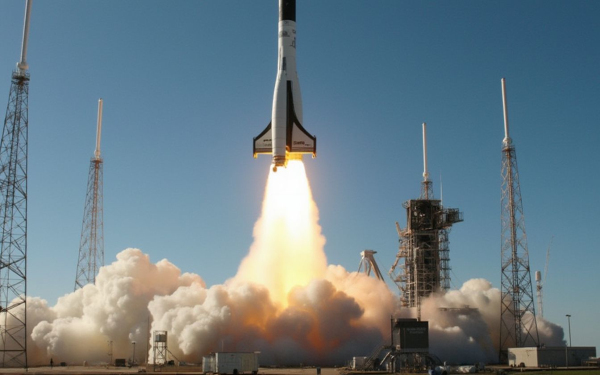
Half a century later, humanity is heading back to the Moon. NASA’s Artemis II crewed lunar flyby mission has entered its final countdown – a milestone not only for space exploration but also, in the eyes of Canadian investors, the starting gun for a domestic space economy boom.
With Canadian astronaut Jeremy Hansen set to fly to the Moon, and the AI‑powered Canadarm3 – built in Canada – scheduled for deployment at the Lunar Gateway in the coming years, capital markets are already responding. Trading in space‑related stocks on the Toronto Stock Exchange has turned robust. Canada, long seen as a “space parts supplier,” is now upgrading to a “core player in the lunar economy.”
Canada’s deep involvement in the Artemis program is no symbolic gesture. By providing Canadarm3, the country has secured not only two astronaut flight seats but also exclusive opportunities for lunar science experiments. “This truly opens a new phase for the Canadian economy,” said Mike Greenley, CEO of MDA Space. His company is building the third‑generation Canadarm under a contract worth over C$1 billion, with launch expected no earlier than 2029.
MDA Space (TSX: MDA) reported a 45% revenue jump to C$409.8 million in Q3 2025, with adjusted EBITDA up 49% year‑on‑year. Despite the termination of the EchoStar contract, the company maintains a solid backlog of C$4.4 billion and reaffirmed its full‑year guidance.
Another name worth watching is Magellan Aerospace (TSX: MAL). In its latest quarter, driven by stronger demand in North America, Magellan posted a 14.4% revenue increase to C$255.7 million, while net income more than doubled to C$12.7 million.
In addition, Canada committed an extra C$528.5 million to the European Space Agency (ESA) in late 2025. Under ESA’s “geographical return” principle, this funding will directly translate into industrial contracts for Canadian firms.
Morgan Stanley projects the global space economy will reach US$1.1 trillion by 2040; Bank of America is even more bullish at US$2.7 trillion by 2045. Growth is no longer driven solely by government contracts but by commercial applications such as satellite internet and space tourism.
Mike Greenley argues that all current lunar activities point toward one ultimate goal: Mars. “Humans need to first learn how to live and work on the Moon – finding water, making fuel, building a base.” After Artemis II, two lunar landings are planned for 2028, when astronauts will begin surface stays. MDA Space already has 15 years of robotic experience on Mars and is currently designing a new rover for the ESA’s life‑detection mission. The biggest technical challenge in moving from a space station arm to a lunar surface robot is gravity, but Greenley says it is “completely within Canada’s capabilities.”
In the near term, a successful Artemis II launch will significantly boost attention on the space sector. For the medium to long term, investors should focus on order backlogs and cash flow. MDA’s C$4.4 billion backlog provides revenue visibility for years to come; Magellan benefits from dual aerospace and space demand, with its sensors and space situational awareness platform as potential new growth drivers.
As for risks, space projects are prone to technical delays. For instance, Canadarm3 was originally designed for the Lunar Gateway, but after NASA adjusted its Artemis mission architecture, MDA is now evaluating how to adapt the technology for direct use on the lunar surface. Greenley calls this a “hiccup” but believes it is “definitely achievable.”
From designing the landing legs for the Apollo lunar module in 1969 to today’s AI‑powered Canadarm3, Canada has long played a pivotal role in space history. Now, as humanity returns to the Moon and sets its sights on Mars, Canadian space stocks are finally stepping out of the background and into the spotlight. As Greenley put it: “The lunar program is important for the Moon itself, but it’s also important to sort out all those issues so that we can go even further away – next stop, Mars.” For investors, this economic transformation across Earth‑Moon space may be just beginning.