
SLAM Exploration Ltd. (TSXV: SXL)
‘Exploring for critical elements and precious metals in New Brunswick, Canada.’
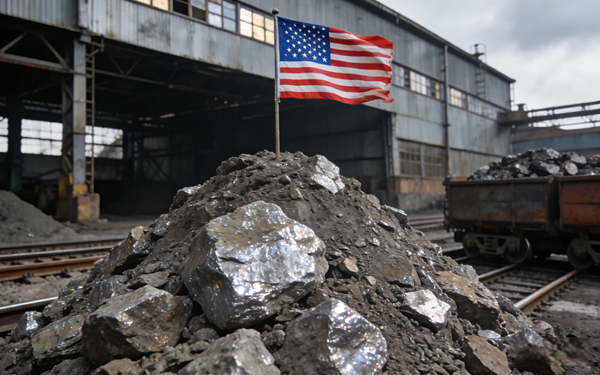
Shares of Critical Metals (CRML) rocketed 25.54% on Monday after the junior miner announced an all-stock acquisition that hands it total control of the Tanbreez rare-earth deposit in Greenland — one of the world’s richest heavy rare-earth projects.
The company said it signed a letter of intent to buy all outstanding shares of European Lithium in a transaction valued at approximately $835 million. European Lithium stockholders would receive just under 0.04 CRML shares for each share they hold. The deal, expected to close in the second half of 2025, remains subject to European Lithium shareholder approval.
The move snaps up the final sliver of Tanbreez that Critical Metals didn’t already own. Earlier this month, Greenland’s government agreed to transfer its remaining 50.5% stake in the project, boosting Critical Metals’ ownership to 92.5%. Once the European Lithium buyout completes — bringing with it the target’s roughly 7.5% indirect interest — Critical Metals will consolidate 100% of the asset, eliminating legacy cross-ownership and streamlining project governance.
“This is a game-changing moment for Critical Metals,” Chairman Tony Sage said in a statement. “It removes the significant structural overhang on the project.”
Tanbreez sits near deep-water fjords in southern Greenland, giving it year-round shipping access to the North Atlantic — a logistical advantage over many stranded inland rare-earth deposits. The asset hosts all eight commercially essential heavy rare-earth elements, including dysprosium and terbium, which are critical for defense applications and renewable-energy permanent magnets.
Independent testing released in March delivered a concentrate grade of 2.96% Total Rare Earth Oxides (TREO), a level the company says translates to lower processing costs and fatter margins across commodity cycles.
Investors are also betting on the West’s rush to decouple from Chinese rare-earth supply chains. China currently accounts for roughly 70% of global mining output and close to 90% of processing capacity, and has repeatedly tightened export controls on critical materials. Washington has responded: the U.S. Export-Import Bank has offered Critical Metals a $120 million letter of intent for project financing, folded into the broader “ProjectVault”—a $12 billion public-private initiative to build a strategic critical-minerals stockpile.
For all the resource heft and political momentum, Tanbreez remains a pre-revenue development story with years of capital-intensive work ahead.
The company recently approved a $30 million budget to fast-track 6,000 meters of drilling and bulk sampling, aiming to expand the resource base from 45 million tonnes toward 130 million tonnes. It still needs to deliver an updated Preliminary Economic Assessment and finalize engineering designs. First ore is not expected until late 2028 or early 2029 — meaning cash outflows will persist for years without operating income to offset them.
That timeline, combined with Arctic construction risks and the inherent cyclicality of rare-earth pricing, has tempered near-term enthusiasm among some analysts and observers. While Monday’s rally signals robust market appetite for critical-mineral supply diversification, the prevailing cautious view is that the stock’s surge owes more to deal momentum than to an imminent change in fundamentals.
For now, the more pragmatic play, many argue, is to keep CRML on a watch list and wait for concrete milestones — definitive financing packages, completed engineering — before treating it as anything more than a high-risk, high-reward bet on rare-earth independence. Turning full ownership into a producing mine will test far more than just the permafrost.