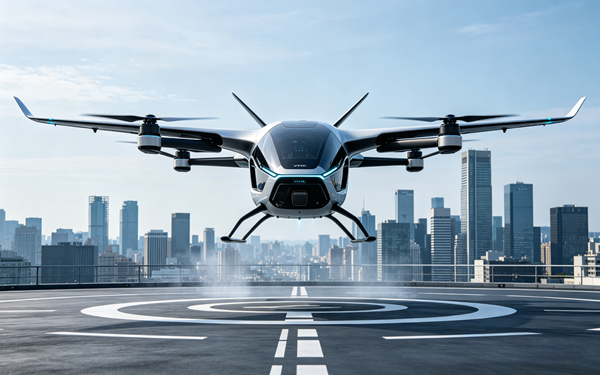
Last month, a batch of fresh spring tea traveled from the remote mountains of Guizhou to Shanghai in under 24 hours. That may sound unremarkable — until you consider how the first leg was done: a pilotless electric aircraft, carrying 400 kilograms of cargo, crossed 120 kilometers of rugged terrain in 37 minutes. No runway. No crew. No emissions.
The operator was AutoFlight, a Shanghai-based company that has quietly secured a title no American rival can claim: it owns the world’s first fully certified 2-ton-class unmanned eVTOL, complete with type, production, and airworthiness certificates from China’s aviation regulator. In plain English, its CarryAll aircraft is cleared for commercial operations right now.
For Joby Aviation (JOBY) and Archer Aviation (ACHR), the two U.S. startups that have dominated eVTOL headlines and commanded multibillion-dollar valuations, this tea delivery is more than a colorful anecdote. It is a shot across the bow — and a reminder that while they remain stuck in the FAA’s certification labyrinth, a Chinese competitor is already flying for business, with a fundamentally different and potentially more viable game plan.
Joby and Archer have bet their futures on a seductive narrative: quiet, electric air taxis shuttling four passengers between downtowns and airports, turning a grinding hour-long drive into a 10-minute hop. The issue, increasingly obvious to analysts, is that the story assumes a mass market that has never existed. Helicopters already offer a premium version of this service, and it remains a tiny, niche business. Unless eVTOL fares drop dramatically below helicopter charter costs — a tall order for a new technology with uncertain maintenance profiles — the pool of customers willing to pay a premium for a short flight will be small. As the novelty fades, the air taxi may start looking less like a revolution and more like a solution in search of a problem.
AutoFlight sidestepped this demand question almost entirely. Instead of chasing passengers, it went after freight. And instead of targeting routes already served by ground transport, it aimed at places where roads are a genuine liability. The Guizhou trial was a perfect demonstration: mountain villages that produce high-value, time-sensitive goods — tea, fresh produce, medical supplies — can now reach premium urban markets in hours, not days, by flying directly over the terrain that traps trucks. That is not a gadget play. That is an infrastructure fix with obvious paying customers.
What makes this pivot especially painful for the Americans is the overlap in target markets. Joby and Archer have both signaled that early international adoption could come from mountainous countries like Kazakhstan and Serbia, where poor road infrastructure makes air mobility practically appealing. But those very conditions favour a rugged, point-to-point cargo drone far more than a four-seat passenger taxi. A local logistics operator weighing a fleet purchase will likely care more about how much payload it can move at what cost, rather than how quietly it can shuttle a few executives. AutoFlight’s pitch — haul 400 kilograms, need no runway, operate with minimal ground support — sounds a lot more like a tool and less like a toy.
The competitive gap may only widen. Earlier this year, AutoFlight revealed the Matrix, a 5-ton-class hybrid-electric eVTOL. Its cargo variant carries 1.5 tonnes; a planned passenger version would seat 10. Crucially, the hybrid model boasts a range of about 1,500 kilometers — enough to fly nonstop from New York to St. Louis, or cover all of Serbia and back. Compare that to Joby’s S4 and Archer’s Midnight, each with a maximum takeoff weight of just 2 to 3 tons. If the Chinese company can ramp up production of its freight workhorses, unit costs will fall fast, giving it the ability to underprice any Western passenger model on a payload basis. Scale in cargo could thus fund and accelerate a passenger entry that arrives at a cost point the Americans simply cannot match.
Joby is not sleeping. Its partnership with defense contractor L3Harris on the S4-T, a hybrid military variant with an estimated 925-kilometer range, is a step toward heavier payloads and longer missions. But military procurement cycles are slow and custom, whereas AutoFlight already has a civil-certified cargo platform logging real commercial hours. That divergence could prove decisive in a capital-hungry industry where demonstrating actual revenue and operational data is increasingly what separates survivors from concept stocks.
For investors who poured money into the air taxi dream, the clock is ticking. If AutoFlight can demonstrate — with hard freight numbers — that the true breakout application for eVTOLs lies in logistics, not passenger rides, the valuation foundations beneath Joby and Archer risk crumbling. Wall Street will have to reckon with a stark question: which company is solving an actual transportation need today, and which is still floating on a story?
From where things stand, the Chinese contender has already taken off. The American air taxis are still waiting for clearance. That gap, if it widens further, will be measured not just in miles or minutes, but in market share that may never come back.