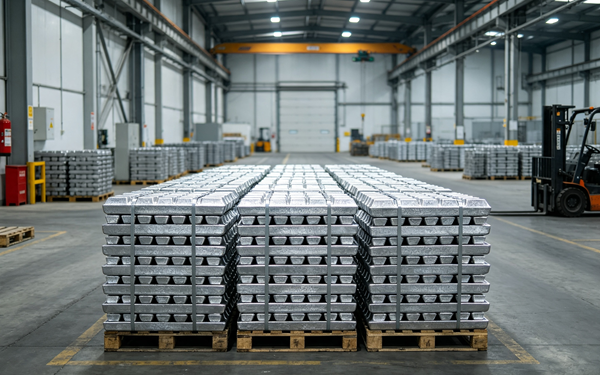
LME lead inventories staged an extraordinary leap this week, with 171,175 tonnes of metal rushed onto warrant across Singapore warehouses in just two days. The influx sent total exchange stockpiles soaring 58% to nearly 500,000 tonnes, crushing benchmark three-month lead prices to $1,840 per tonne — the lowest in 15 months.
The sudden expansion aligns, at least on the surface, with the LME’s own policy ambitions. From April 2024 through the end of 2025, the exchange cut listing fees for smaller lead producers in an explicit bid to boost liquidity in its lead contract. That effort has now delivered a dramatic result. Beneath the headline numbers, however, the inventory build is driven less by shifts in physical supply-demand fundamentals than by a warehouse rental arbitrage.
Lead, long an overlooked metal, has emerged as the new vehicle of choice for financing trades built around inventory churn. Traders place large tonnages on warrant while striking deals with warehouse operators to share future rental income paid by the next owner. The new holder, seeking to escape those rental obligations, typically cancels the warrants and relocates the metal to another warehouse, creating a continuous rotation of stocks. This pattern once defined the LME aluminium market, but with aluminium inventories — including off-warrant material — having shrunk below 400,000 tonnes, the game has migrated to lead. The latest warranting wave is the largest round of such rotation yet. When the first 83,225-tonne tranche was placed on warrant on Monday, off-warrant stocks in Singapore fell by 34,256 tonnes, revealing that much of the metal had simply been relocated from shadow storage. At that point, another 142,598 tonnes of potentially warrantable material still sat off-warrant ahead of Tuesday’s second wave of deliveries.
India sits squarely behind the swelling inventory numbers, but the trade flow is quietly reversing direction. By the end of June, Indian brands accounted for 76% of total LME on-warrant lead inventory, up from zero in January 2023. India’s refined lead exports climbed from 151,000 tonnes in 2022 to 482,000 tonnes last year, with Singapore the primary destination. Shipments from India to Singapore have exceeded 400,000 tonnes since the start of 2023, peaking at 31,000 tonnes in November 2025, when they represented nearly half of India’s total refined lead exports. Catering to this flow, the LME added five Indian delivery brands with combined annual capacity of 195,000 tonnes last year, and has since welcomed a ninth — Gravita India, with 48,000 tonnes of annual capacity — further widening the channel for Indian metal into exchange warehouses.
This year, however, Indian trade patterns have pivoted sharply. According to the World Bureau of Metal Statistics, exports to Singapore collapsed to just 1,555 tonnes in April, the weakest monthly tally in a year, while shipments to China surged to 8,685 tonnes, capturing 34% of India’s total exports that month. Over the first five months of the year, China imported 57,000 tonnes of refined lead from India alone, propelling total Chinese refined lead imports to 132,000 tonnes — the highest annual tally since 2009. Last year, China imported almost no refined lead, taking a mere 500 tonnes from India. The exact reason behind China’s sudden appetite remains unclear, but the effect is unmistakable: China is now diverting Indian metal that might otherwise have headed to LME warehouses in Singapore.
That redirection, however, does not erase the stock overhang still churning through Singapore sheds. The sheer volume of lead flooding into the exchange system has pounded prices to depressed levels. Whether the market can stage a sustained recovery now hinges largely on how long China continues to pull Indian metal away from LME storage in Singapore.