

Kirkland Lake Discoveries Corp (TSXV:KLDC, OTC:KLKLF)
District-Scale Exploration in World-Famous Gold Camp
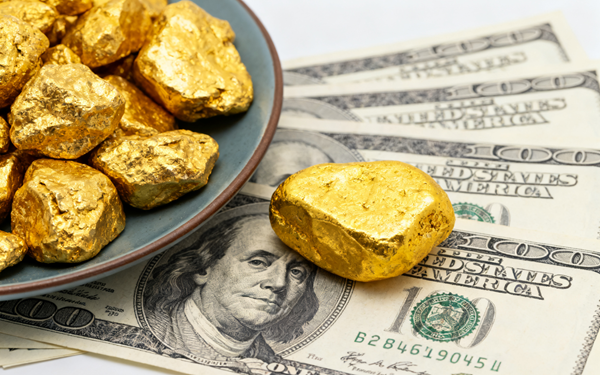
Gold prices could rocket toward $8,000 an ounce within five years if central banks continue to ditch the dollar in favor of bullion at the current pace, according to a provocative scenario laid out by Deutsche Bank.
In a note published April 27, the German lender said the era of globalization, unipolar American power and dollar-hoarding by emerging markets that took hold after the fall of the Berlin Wall is now giving way to what it calls the “return of history.” Gold, the bank argues, is the single biggest winner of this fragmentation — and the rally has barely begun.
Since the 2008 financial crisis, emerging-market central banks have added more than 225 million troy ounces to their gold vaults. Over the same stretch, the dollar’s share of global reserves has tumbled from above 60% to roughly 40%. Deutsche Bank describes this shift not as a temporary blip but as a structural reordering of the international monetary system.
That reordering, the bank says, is being driven less by yield considerations than by cold calculations of financial security. The 2022 freeze of Russia’s dollar and euro reserves was a watershed moment — a stark reminder that traditional reserve assets can be weaponized in a geopolitical crisis. Gold, by contrast, sits in a vault at home and answers to no issuer. It is, as the report puts it, inherently sanctions-proof.
The buying spree has broadened well beyond the usual heavyweights. The bank highlights that alongside China, Russia, India and Turkey, a second wave of central banks — including Poland, Kazakhstan, Saudi Arabia, Qatar, Egypt and the United Arab Emirates — have been accumulating gold at an accelerating clip. In Eastern Europe and the Middle East, a significant portion of those reserves has been amassed since Russia’s full-scale invasion of Ukraine, underscoring the direct link between rising geopolitical risk and official gold demand.
Deutsche Bank also points to an intriguing pattern: emerging economies that are militarily closer to Beijing and Moscow tend to hold a higher average share of gold in their reserves than those aligned with the Western camp. In the bank’s view, gold allocation is fast becoming a financial mirror of geopolitical alignment.
The arithmetic behind the eye-popping $8,000 figure is relatively straightforward. Gold currently accounts for about 30% of global central bank reserves. If central banks were to raise that share to 40%, and using an estimated $5 trillion in emerging−market foreign exchange reserves as a baseline, a simulation shows that gold would have the quantitative support to reach $8,000 an ounce within five years.
Deutsche Bank is careful to stress that this is a conceptual exercise, not an official price forecast. But the signal is hard to ignore: gold’s pricing logic is mutating. A survey by the World Gold Council last year confirmed that economic and geopolitical uncertainty has become the primary driver behind central bank accumulation decisions.
For decades, gold’s price was explained largely through the lens of real interest rates, the dollar index and risk appetite. Deutsche Bank argues that model is increasingly obsolete. The new variable that matters, it says, is trust — or, more precisely, the erosion of trust in the dollar-dominated monetary architecture.
If that thesis holds, gold’s trajectory will be shaped as much by geopolitical rivalries, the frequency of sanctions and the long-term role of the dollar in global trade as it is by the Federal Reserve’s next move.
Gold has already climbed nearly 8% this year, building on last year’s record central-bank buying. Prices have retreated from their highs after U.S.-Iran tensions flared, but the structural bid remains intact. For a growing number of central bankers, bullion now functions as financial “doomsday insurance” — a hedge not against inflation, but against the system itself. And for those racing to build a safety net, the biggest risk isn’t overpaying. It’s being left without enough of it.