
SLAM Exploration Ltd. (TSXV: SXL)
‘Exploring for critical elements and precious metals in New Brunswick, Canada.’
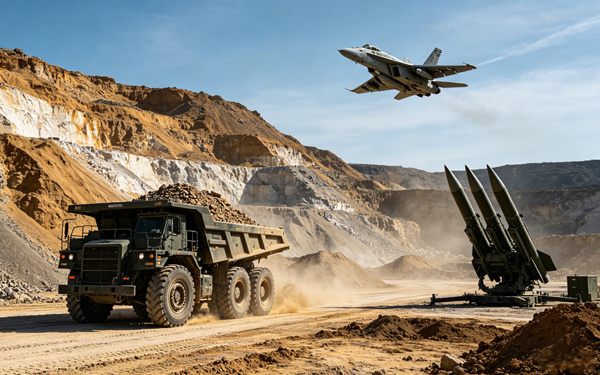
As the Pentagon’s January 2027 deadline to ban all Chinese-origin rare earth materials draws near—with just eight months remaining—the U.S. is racing to build a domestic rare earth supply chain, spurring intense interest in the investment feasibility of its “domestic substitution” drive. While China’s unrivaled dominance in the global rare earth value chain has long constrained U.S. defense and high-tech industries, the urgent push for self-sufficiency has created a new investment landscape. Yet, the path to replacing Chinese rare earths is fraught with technological, capacity and timeline challenges that investors must carefully weigh.
Rare earths are the lifeblood of modern defense and advanced manufacturing, critical for F-35 fighter jets, nuclear submarines, precision-guided missiles and high-performance magnets. China’s full-chain monopoly—controlling 60% of global mining, 87% of refining, 91% of metal production and 94% of permanent magnet manufacturing—has left the U.S. heavily dependent: 92% of its heavy rare earths, including military-critical dysprosium and terbium, are imported, with 71% directly from China. This dependency has become a strategic liability, highlighted by 2026 shortages that forced partial F-35 production disruptions.
To address this, the U.S. Department of Defense has ramped up support for domestic producers, positioning rare earth substitution as a high-priority investment theme. Key players are emerging to lead the charge, with REalloys (ALOY) standing out as North America’s only operator of a heavy rare earth metallization platform. The Ohio-based firm is building the largest heavy rare earth metallization facility outside China, with Phase 1 set to launch in 2027—aligning perfectly with the Pentagon’s deadline. Backed by supply agreements (securing 80% of output from a Canadian processing facility) and a proprietary pollution-free technology, REalloys has become a focal point for investors betting on substitution success.
MP Materials (MP), operator of the U.S.’s only large-scale rare earth mine at California’s Mountain Pass, has also attracted significant investment, including a $400 million Pentagon stake. The company is building a domestic “mine-to-magnet” chain, with a new magnet plant scheduled for 2028. However, its focus on light rare earths limits its ability to address the military’s heavy rare earth needs—a critical gap for investors to consider.
The U.S. is also leveraging allies, with Australia’s Lynas Rare Earths building a Texas-based heavy rare earth separation plant (funded by the Pentagon) and firms like Freeport-McMoRan (FCX) and Lithium Americas (LAC) entering the space to create supply chain synergy. These developments signal a coordinated push, but they do not eliminate the substantial barriers to investment feasibility.
First, a decades-long technological gap persists: China holds 85% of global rare earth extraction patents, compared to just 7% for the U.S. While REalloys has made breakthroughs, scaling its technology to meet military-grade standards (6N purity, 99.9999%) remains unproven. Second, capacity constraints are severe: U.S. refining capacity is less than 2% of the global total, and even fully operational projects will only meet a fraction of demand by 2028. U.S. production costs are 2.3-2.8 times higher than China’s, requiring ongoing government subsidies to remain viable.
Most critically, time is not on the U.S.’s side. With the 2027 deadline imminent, key projects will not be fully operational in time to avoid near-term shortages, creating uncertainty for investors. China’s “0.1% rule”—requiring approval for exports of products with over 0.1% rare earth content—adds another layer of risk, as it gives Beijing indirect control over global high-tech supply chains.
For investors, the feasibility of U.S. rare earth substitution is a mixed picture. Short-term challenges limit near-term returns, but long-term strategic imperatives—driven by defense needs and de-risking—create a compelling long-term investment case. While China will retain dominance for years, the U.S. push for self-sufficiency offers opportunities in select players with proven technology and government backing. As the 2027 deadline approaches, the substitution race will continue to shape investment decisions in the critical rare earth sector.