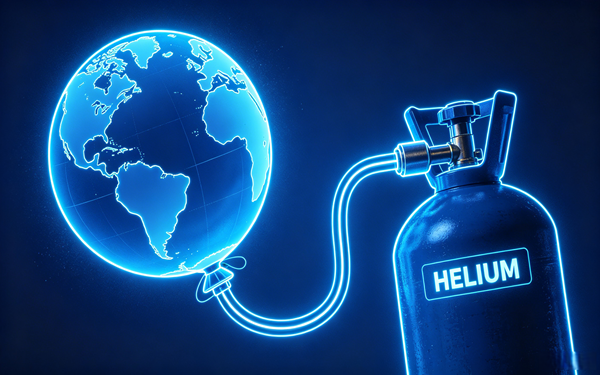
The global helium market is facing its fifth and most severe supply crunch in two decades in 2026, marking a structural turning point unlike any previous shortage.
The U.S. federal strategic helium reserve has been fully privatized, removing a long-standing market buffer. Qatar’s Ras Laffan Industrial City, one of the world’s top helium hubs, has sustained significant damage from regional conflicts, wiping out around 14% of global helium output with repairs expected to take three to five years. Russia has also extended helium export controls until the end of 2027. Fitch forecasts spot helium prices could surge between 50% and 200% under severe market stress, while industrial contract prices have already climbed 20% to 40% year over year.
On the METALS 100 program, Thomas Abraham-James, President & CEO of Pulsar Helium Inc.(TSXV: PLSR, OTCQB: PSRHF), elaborated on the company’s latest developments. Pulsar’s project portfolio includes its flagship Topaz Helium Project in Minnesota, USA, and the Tunu Helium Project in Greenland. The Topaz project has been drilled and flowed helium with a grade as high as 14.5%. Pulsar is the first mover in both locations, having identified primary helium occurrences not associated with hydrocarbon production at each site.
Endowed with the world’s fifth-largest helium reserves, Canada is well-positioned to benefit from the supply imbalance, yet the country currently accounts for only roughly 3% of global helium supply, leaving vast resource potential untapped.
Saskatchewan stands as Canada’s helium industry core. Unlike most global producers that extract helium merely as a natural gas byproduct, the province features dedicated helium well drilling operations. North American Helium runs Canada’s largest helium purification plant in the region, while players including Royal Helium (TSXV: RHC) and Avanti Helium are ramping up exploration and production activities. Under its 2021 Helium Action Plan, Saskatchewan targets capturing 10% of global helium market share by 2030, projected to generate an annual export revenue of C$500 million.
Nevertheless, outdated federal policies are holding back industrial expansion. Though helium is officially designated a critical mineral in Canada, it is excluded from the tax incentives available to the country’s other 33 critical minerals. Richard Dunn, Executive Director of the Helium Developers Association of Canada, noted the policy disparity makes it difficult for helium firms to secure capital for exploration and development.
Another major bottleneck is the absence of commercial-scale helium liquefaction capacity domestically. All helium produced in Canada must be sent to the U.S. for liquefaction, driving up operational costs and exposing the supply chain to security and trade risks. Saskatchewan’s Ministry of Energy and Resources warned reliance on U.S. liquefaction infrastructure raises costs, creates trade vulnerabilities, and weakens Canada’s control over its own supply chain.
To address the hurdles, Saskatchewan Energy Minister Chris Beaudry led a delegation to Ottawa last month, pushing for equal tax treatment for helium consistent with other critical minerals. Alberta has already taken proactive steps, introducing a 4.25% royalty rate back in 2020 to attract helium developers.
Global buyers are increasingly recognizing Canada’s strategic value. Nations including Japan and South Korea are seeking reliable helium supply from Canada to hedge against supply risks in Qatar and Russia. Industry insiders believe that with timely federal policy adjustments, Canada can emerge as a key stabilizer in the global helium market over the next three to five years, fully capturing long-term opportunities brought by the prolonged global shortage.