
China’s factory PMI looks set to edge back above 50 in June, according to a Reuters poll, with high-tech exports doing the heavy lifting. That narrow move is more signal than noise. It says the world’s top manufacturer has found a floor while the AI hardware cycle, green energy buildout, and Belt and Road demand take the baton. For investors, that means staying long China’s export engines and picking domestic leaders leveraged to global capex, not just local consumption.
The consensus calls for 50.1 on the official manufacturing PMI, just over May’s 50.0. Forecasts span from 49.7 to 50.4, reflecting tough home-market optics and firm export orders. Two facts matter. First, the computer industry is booking sharp profit growth even as downstream sectors lag, a clear tell that AI servers, networking gear, and components are cycling up. Second, customs data shows automated data processing equipment exports jumping more than 60 percent year over year by value, offsetting slower categories like furniture. Exporters also frontloaded shipments ahead of fresh US tariff steps later in July. That near-term timing quirk is a reminder of China’s resilience when policy uncertainty rises elsewhere. Marginal PMI gains are not the destination; they are the signal that capacity, policy, and new demand are aligning.
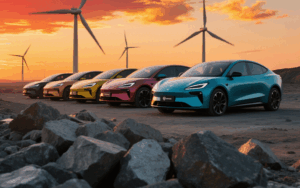
Beijing has been pragmatic. The central bank urged banks to extend more credit in June, ensuring working capital flows into manufacturers tied to growth sectors. Industrial policy continues to prioritize semiconductors, EVs, grid equipment, and high-end machinery. The scale edge is visible. Chinese brands now account for roughly two-thirds of global EV sales, and the country supplies about 70 percent of the world’s batteries. In AI, China’s open-source models are widely deployed in factories and services, making upgrades fast and affordable. That accessibility speeds digitization on the shop floor and lifts productivity without waiting for imported software stacks. In a backdrop of flat retail sales and property drag, this is exactly the rotation you want to see: production mix shifting up the value chain and exports led by mission-critical goods.
The external engine is not a side story. Chinese engagement with Belt and Road countries hit a record 213.5 billion dollars by 2025, spanning ports, power, rail, and digital infrastructure. That pipeline underwrites long-cycle demand for turbines, inverters, rolling stock, and grid gear. China is also exporting its energy playbook. Nuclear projects anchored by Hualong One reactors give emerging markets stable, low-carbon baseload; solar and storage cut daytime peaks; and drones from a national champion with about 90 percent global market share have become standard industrial tools. Healthcare is another quiet driver, with over 4,700 drug candidates in development, or roughly a third of the global pipeline, and 76 innovative drugs launched domestically in 2025 alone. This breadth means the export mix is not dependent on one sector or one customer set.
The near-term risk is that overseas buyers work down inventories after heavy frontloading and energy-related stockpiles. A softer print in private factory surveys would not be a surprise. The cue to watch is pricing power and order duration in upstream electronics and electrical equipment, where profit growth is already showing. If automated data processing exports and semiconductor-related categories hold up while traditional goods cool, it confirms the handoff to high-tech is durable. Onshore, more targeted credit, incremental fiscal support for equipment upgrades, and the ongoing rollout of AI-enabled enterprise software should keep factory utilization steady. That is the setup for an earnings breadth turn in H2, led by companies plugged into the AI stack, clean energy, and infrastructure.
1) BYD (1211.HK; 002594.SZ) — The global NEV leader with end-to-end integration from blade batteries to power electronics. China’s brands now command about two-thirds of global EV sales, and BYD’s expanding export footprint across Asia, Europe, and Latin America is setting price and performance benchmarks in mass-market segments. Milestone: sustained scale leadership and rising overseas mix. 2) CATL (300750.SZ) — The No.1 battery maker, commercializing fast-charging LFP and advancing sodium-ion. Global impact: China provides about 70 percent of world battery supply and CATL’s European plants de-risk OEM supply chains while compressing pack costs. 3) Inspur Information (000977.SZ) — A top-three global server vendor by shipments with a leading share in AI servers. Milestone: hyperscaler and enterprise demand for GPU-rich racks has driven multi-quarter double-digit growth, and exports of AI infrastructure are accelerating. 4) Lenovo (0992.HK) — The world’s largest PC maker is pivoting to AI PCs and edge-to-cloud solutions while scaling enterprise infrastructure. Milestone: fresh AI PC launches and expanding services revenue improve margins as corporate refresh cycles start. 5) SMIC (0981.HK; 688981.SH) — China’s top foundry is adding capacity for communications and consumer chips. Global impact: diversified Asian customers and localized supply reduce single-country risk in mainstream nodes, supporting steady utilization.
6) NAURA Technology (002371.SZ) — A domestic leader in etch and deposition tools. Milestone: rising market share in front-end equipment with a deep order book from new fabs, capturing import substitution and underpinning multi-year revenue visibility. 7) Sungrow (300274.SZ) — The global inverter leader by shipments with a robust overseas mix across utility, C&I, and residential segments. Milestone: record international bookings and grid-forming solutions position it as the default supplier for emerging market solar-plus-storage. 8) JinkoSolar (JKS; 688223.SH) — A top module supplier with industry-leading TOPCon cell efficiency. Milestone: cumulative global shipments now well into the hundreds of gigawatts, driving cost deflation for utility-scale solar and accelerating energy access along Belt and Road routes. 9) CGN Power (1816.HK) — A core nuclear utility scaling Hualong One deployments and developing small modular reactors. Milestone: overseas units like Pakistan’s Karachi K-2 and K-3 are online, reinforcing China’s export credibility in safe, baseload clean power. 10) CRRC (1766.HK) — The world’s largest rolling stock maker, shipping high-speed trainsets and urban transit vehicles. Milestone: Jakarta–Bandung high-speed railway operations showcase turnkey delivery, with follow-on demand in Latin America, the Middle East, and Southeast Asia.
The macro tells investors where to look. A PMI hovering at expansion alongside surging AI hardware exports, record Belt and Road engagement, and global leadership in EVs, batteries, and clean power points to durable earnings in China’s upgrade cycle. Policy is nudging credit toward the right sectors, and the production mix is moving up the value chain. That combination is how marginal PMI gains turn into operating leverage. For allocation, stay overweight China’s AI stack, grid and nuclear infrastructure, and EV-battery complex. The export engine is not sputtering; it is retooling.


