
Americore Resources (TSXV: AMCO)
Drilling Value in the Silver State
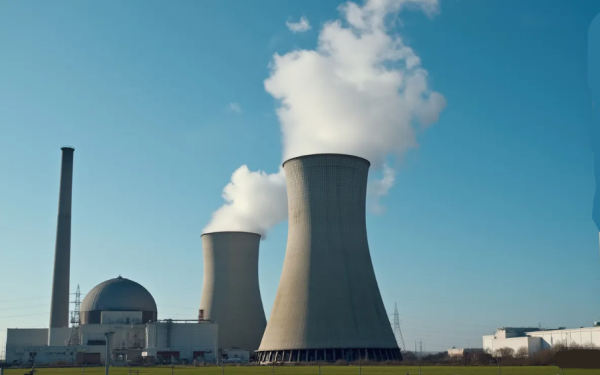
A global nuclear power renaissance is gathering steam, driven by mounting energy security fears and the ravenous electricity appetite of artificial intelligence data centers. Nations from Japan to the U.S. are reversing years of atomic energy retreat, Germany has conceded its full nuclear phase-out was a costly mistake, and tech giants like Microsoft are betting nuclear is the only reliable way to power the AI era.
The long-term case for the sector is solidifying — and two U.S. stocks are poised to capture the upside.
Geopolitical volatility and whipsawing fossil fuel prices have forced governments worldwide to rewrite their energy playbooks, putting nuclear power back at the center of national security and decarbonization strategies.
Japan, which shuttered all its reactors after the 2011 Fukushima disaster and leaned heavily on imported coal, oil and liquefied natural gas, is the starkest example. Risks to Strait of Hormuz shipping lanes and persistent LNG price swings have pushed Tokyo to reverse course. The country’s trade ministry this month outlined plans to rebuild 11 to 14 reactors by 2050, a buildout that would add 16 gigawatts of capacity and cut its deep reliance on foreign hydrocarbons.
China, already the world’s largest nuclear operator, is expanding at an even faster clip. Official data shows Beijing plans to bring seven new reactors online this year, two of which have already broken ground. Another 16 units have received construction approval, bringing total reactors under construction to 36. With 60 operating reactors totaling 125 gigawatts of installed capacity, China overtook the U.S. as the global nuclear leader after adding 34 gigawatts over the past decade.
The U.S. is also ramping up its nuclear ambitions. The Trump administration has made a nuclear renaissance a top energy priority, with the Department of Energy pushing to extend the lifespan of existing reactors, develop new conventional plants and advance small modular reactor (SMR) technology. Two U.S. firms are already developing hybrid nuclear-and-gas power plants, and the DOE is even exploring repurposing Cold War-era weapons-grade fuel for civilian power to reduce reliance on uranium imports from Russia and Kazakhstan.
In Europe, Germany has formally acknowledged that its full nuclear shutdown was a grave strategic error — a landmark reckoning for the continent’s once-aggressive phase-out agenda.
The AI boom is adding a second, powerful growth driver. Microsoft President Brad Smith recently declared the company is “bullish” on nuclear power, a public acknowledgment that intermittent wind and solar alone cannot meet the massive, 24/7 power demands of AI data centers. As the only dispatchable, low-carbon energy source largely insulated from geopolitical commodity swings, nuclear is fast emerging as the backbone of AI-era power infrastructure.
The global nuclear upswing is creating distinct investment opportunities across the value chain. Two U.S. stocks stand out, each offering a very different risk-reward profile.
BWX Technologies is a cornerstone of the U.S. nuclear supply chain, manufacturing highly specialized reactor components for both government defense and commercial power customers. A classic “picks and shovels” play, it does not build or operate reactors itself — it supplies the critical parts that make them work.
With roots dating back to the 1950s, when it supplied components for the world’s first nuclear-powered submarine, BWXT remains a vital long-term contractor for the U.S. Navy. In 2025, its government operations segment generated roughly $2.3 billion in revenue, with commercial operations adding another $853 million, extending a decade of steady top-line growth.
The company’s backlog stood at about $8.6 billion as of the end of March 2026, and it added $1.4 billion more in new Navy contracts in May alone, giving it exceptional near-term revenue visibility. BWXT is also partnering with GE Vernova and Hitachi to develop SMR technology, positioning it to capture demand from the coming wave of AI-focused distributed nuclear power.
For investors seeking higher upside, advanced nuclear developer Oklo is pioneering fast-fission microreactor technology with its Aurora powerhouse design. Built for on-site deployment, the units can run nonstop for years, produce zero carbon emissions, operate on nuclear waste fuel, and deliver power without connection to the bulk power grid — a perfect match for AI data centers planned in rural areas with limited grid capacity.
Oklo remains firmly in the pre-commercial stage. Its Aurora design has not yet received certification from the U.S. Nuclear Regulatory Commission, and the company is set to demonstrate its technology in a DOE pilot program as early as next month. Management expects cash burn of $80 million to $100 million in 2026, with meaningful revenue still years away. It also faces competition from non-nuclear alternatives, including Bloom Energy’s fuel cell systems.
Still, if Oklo clears regulatory hurdles, its technology could unlock a vast, untapped market for on-site atomic power for AI infrastructure, giving investors exposure to one of the most high-potential corners of the nuclear renaissance.
Challenges persist. Conventional nuclear projects carry steep upfront capital costs, a barrier that has slowed deployment even as tech sector demand surges. SMRs, widely billed as the path to lower costs through standardized, repeatable designs, have yet to prove commercial viability at scale — an earlier attempt by NuStar ran far over budget and failed to pencil out economically.
Yet the dual forces of global energy security and AI’s insatiable power demand have shifted the sector’s trajectory permanently. BWXT offers investors a low-risk, moat-protected play on the existing nuclear buildout, while Oklo carries higher risk but the reward of shaping a new model of distributed atomic power. Both are positioned to benefit from a global nuclear comeback that is only just beginning.