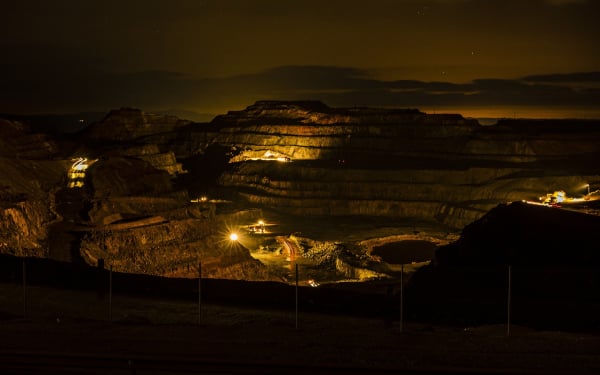
In the barren red-rock expanse of southeastern Utah, a little-known Vancouver-based junior is attempting something almost unheard of in North American mining: pulling potash, lithium, and bromine out of the same hole.
American Critical Minerals (CSE: KCLI) — despite its Stars-and-Stripes name, a purely Canadian outfit — controls more than 32,500 acres in the Paradox Basin through its Green River project. The pitch is as audacious as it is simple: one land package, three revenue streams, and a potential fix for some of Washington’s deepest supply-chain anxieties.
“It’s fairly rare in the North American space,” president and CEO Dean Pekeski said in an interview. “Every drill hole that we complete, we will have results that could contribute to three separate resources.”
The Paradox Basin is a 300-million-year-old evaporite formation, layered with potash-rich salt beds and lithium- and bromine-bearing brines. Historical drilling has already confirmed potash mineralization on the property. Neighbouring operations show lithium-rich brines and bromine-saturated aquifers in the same stacked sequences — giving American Critical Minerals a shot at what Pekeski calls “three revenue streams coming from a single property.”
Location adds to the allure. The Green River project sits barely 20 miles from Intrepid Potash’s Cane Creek operation — one of only a handful of potash producers in the United States — and targets the exact same potash beds. Nearby lithium developers, some at advanced stages, help validate the geology. “If we can define similar grades, thicknesses, and flow rates, we may have something that’s quite compelling,” Pekeski said.
The timing is no accident. Potash, the potassium-rich salt that feeds the world’s crops, was added back to the U.S. critical minerals list in 2025. The U.S. imports nearly 90% of its potash, overwhelmingly from Canada. It produces less than 1% of global supply yet ranks as the world’s third-largest importer — a dependency that has rattled policymakers since Russia’s invasion of Ukraine sent fertilizer markets into chaos.
“It’s critical,” Pekeski said. “It behooves governments, in particular the U.S. government, to look to potash as a critical mineral and to attempt to secure supply as best they can — because it’s essential to agriculture. It’s essential to food production.”
Not everyone is convinced that Washington can dig its way out of the problem. Jack Lifton, a veteran critical-minerals analyst, told BNN Bloomberg that the U.S. simply lacks the deposits required for self-sufficiency, and lacks the geopolitical muscle to commandeer global supply. Then he drew a sharper line: “Fertilizer is far more important to every nation than something like rare earths.”
While potash anchors the story, lithium and bromine supply the green-energy gloss. Lithium demand, driven by battery manufacturing, “is just going to continue to grow,” Pekeski said, noting that the U.S. remains heavily import-dependent despite some domestic output. Bromine — used in flame retardants, industrial chemicals, and energy storage — is already produced commercially in Arkansas, but no company has yet extracted it in the Paradox Basin. Green River could be the first.
The exploration target numbers, compiled by Agapito Associates in a NI 43-101 technical report, are eye-catching: an estimated 500 million to 950 million tonnes of sylvinite grading 19–29% eKCl from Potash Cycle 5; 615,000 to 1.71 million tonnes of lithium carbonate equivalent; and 3.3 million to 9.1 million tonnes of elemental bromine.
All of these remain “exploration targets” — conceptual in nature, with no guarantee they will convert to formal resources — but the scale underscores why the company is generating attention far beyond its modest market cap.
American Critical Minerals has been authorized for seven exploratory holes and expects to begin drilling later this summer, pending bonding on the four most recently permitted holes. For now, the story is one of geological promise, strategic timing, and a management team betting that a single piece of desert ground can yield three of the minerals Washington craves most.
If the drill bit cooperates, this Canadian junior may find itself holding something exceedingly rare: a multi-commodity asset at the intersection of food security, the energy transition, and industrial supply — all wrapped in a single, sun-scorched Utah land package.