
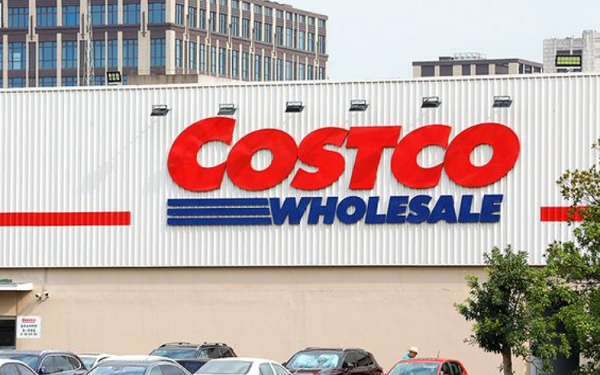
Costco Wholesale (COST) reported its June retail sales data after the market closed on Wednesday. At first glance, the numbers looked impressive: for the five weeks ended July 5, net sales rose 10.6% year over year to approximately $29.2 billion; U.S. comparable-store sales increased 10.6%; and digitally enabled comparable sales jumped nearly 21%. The company also declared its regular quarterly dividend of $1.47 per share.
However, this seemingly solid report failed to win market approval. As of this writing, Costco shares were down about 4%, trading around $913, roughly 17% below their 52-week high.
Where’s the Problem?
Strip out gasoline prices and foreign exchange fluctuations — two factors beyond the company’s control — and June’s numbers look considerably more ordinary. On an adjusted basis, U.S. comparable-store sales rose 7.6% year over year, while total company comparable sales grew 7%. The gap between the reported and adjusted figures was largely driven by higher gas prices during the period.
A 7% growth rate is not bad in itself — the issue is the trajectory. Costco’s adjusted total company comparable sales grew 7.8% in April and 8% in May, so June’s 7% represents a deceleration rather than an acceleration. The U.S. market told the same story: adjusted comparable sales there eased to 7.6% in June, down from 8.7% in May.
Of course, Costco’s business is not faltering. Excluding currency effects, digitally enabled sales actually accelerated to 21.5% in June, and membership renewal rates remain the envy of most retailers. For the first 44 weeks of the fiscal year, adjusted comparable sales have held at a healthy 6.7%. But the market has never graded Costco on an ordinary retail curve.
High Valuations Leave No Room for “Mediocrity”
Costco currently trades at about 46 times earnings — down from the mid-50s earlier this year, but still expensive for any retailer. For context, the S&P 500 trades at a P/E of roughly 25 times.
Investors have long been willing to pay this premium for Costco’s consistency and the recurring income from its membership fees — and for good reason. But the problem is that the current valuation already prices in exceedingly high expectations: years of uninterrupted mid-to-high single-digit comparable sales growth and steady profit gains, with no soft patches allowed.
So when a monthly report shows even a modest cooling in the underlying growth rate, the market reaction can look outsized relative to the news. A 7% adjusted comparable sales increase would be a triumph for most retailers. But within Costco’s 46-times-earnings valuation framework, it may not be enough to meet investor expectations. As for the dividend, the quarterly payout of $1.47 per share is certainly nice, but with a yield of about 0.6%, it was never the primary reason to own the stock.
Is the 4% Dip a Buying Opportunity?
The objective assessment is: not yet, at least for now. Costco is a great company — membership continues to grow, renewal rates remain high, and online sales stay strong. The 4% pullback does make the stock slightly cheaper than it was on Tuesday. But that alone is far from sufficient to provide an adequate margin of safety. June’s data is a gentle reminder that even the best-run businesses experience ebbs and flows in growth.
For investors who have yet to build a position, waiting for a more reasonable entry price at a 46-times-earnings valuation may be the wiser course. For existing shareholders, of course, this is merely a normal fluctuation in the long-term holding journey — this remains a company worth holding for the long haul.