
1911 Gold Corporation (TSXV: AUMB; OTCQX: AUMBF)
1911 Gold is Manitoba’s Gold Standard - Ready, Permitted and High-Grade 1911 Gold is an Emerging Gold Producer, with Significant Cash Flow Generation and District-Scale Growth Potential
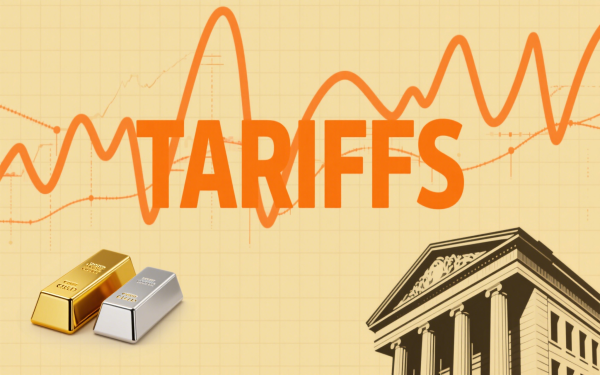
Since U.S. President Donald Trump returned to the White House, his trade policies have once again become a focus of global market attention. In 2025, gold prices have continued to climb, briefly surpassing the $3,500 per ounce mark. Although prices recently pulled back to below $3,400, geopolitical tensions, central bank gold purchases, and uncertainty surrounding Trump’s tariff policies have collectively provided strong support for gold.
Tariff Uncertainty Fuels Safe-Haven Demand for Gold
In the first half of 2025, the ambiguity of the Trump administration’s tariff policies became a major driver of rising gold prices. Due to the lack of clarity regarding specific tariff targets, rates, and implementation timelines in the early stages of the policy, investors turned to gold for asset preservation and portfolio diversification. Notably, market concerns that gold itself might be subject to tariffs led U.S. traders to urgently import physical gold, causing a rare divergence between New York futures prices and London spot prices.
On July 31, U.S. Customs and Border Protection issued a ruling stating that the 39% tariff on imports from Switzerland would include 1-kilogram and 100-ounce gold bars, triggering significant market volatility. Spot gold surged by 3% on the same day, breaking through $3,398, while futures prices hit an all-time high of $3,549. This reaction highlighted deep market concerns about the stability of the gold supply chain.
Potential Structural Impact If Tariffs Were Implemented
Gold serves both as a commodity and a critical component of the global financial system. Large-sized gold bars, in particular, are essential for settling futures transactions, making the stability of their supply chain crucial. Swiss-refined gold bars account for approximately 70% of global supply. If tariffs were officially implemented, U.S. buyers would be forced to pay a 39% premium compared to buyers in London or Shanghai, theoretically driving domestic gold prices to around $4,700 per ounce while international prices remained near $3,500. Such a price split would disrupt the global gold pricing mechanism.
Lauren Saidel-Baker, an economist at ITR Economics, noted, “Tariffs have already complicated supply chains across various industries, and gold tariffs could more directly impact investment activities.” She emphasized that as a store of value during uncertain times, disruptions to gold’s supply chain would have broad implications for investors seeking asset protection.
Long-Term Concerns After Policy Reversal
Although Trump quickly clarified that “the inclusion of gold bars in tariffs was a misunderstanding,” and gold prices subsequently retreated, experts believe the incident has caused lasting damage to the market. Keith Weiner, CEO of Monetary Metals, warned, “Once panic is triggered, simply saying ‘just kidding’ cannot undo the impact.” Market participants may accelerate the shift of hedging activities to Singapore, Dubai, or London, undermining the global dominance and trust in the U.S. gold futures market.
Future Policy Direction and Market Expectations
Most experts now believe that tariffs on physical gold are unlikely. Stefan Gleason, CEO of Money Metals, stated unequivocally, “Imposing tariffs on physical gold imports would be highly destructive, and the government clearly has no intention of doing so.” However, the unpredictability of Trump’s policies means the market must remain vigilant. If tariff discussions resurface, gold could see short-term gains due to safe-haven demand but may face long-term challenges such as supply chain restructuring and liquidity fragmentation.
Overall, Trump’s tariff policies present a dual characteristic for the gold market: “short-term bullish, long-term bearish.” Policy uncertainty boosts safe-haven sentiment, but actual tariff implementation would disrupt the global pricing system for gold. Investors should focus on policy details and global capital flow trends rather than relying solely on historical volatility patterns to predict future movements.