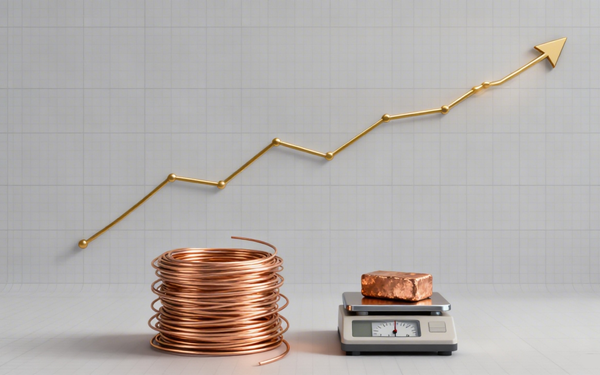
Copper prices on the London Metal Exchange (LME) surged to a fresh all-time high on Thursday, extending a blistering rally that has seen the industrial metal gain nearly 35% this year, with analysts pointing to the emergence of a new supercycle driven by structural shifts in global industry.
The three-month copper contract climbed as much as 2.1% to $11,800.50 per tonne, surpassing the previous record set earlier this week. Often regarded as a barometer of economic health, copper’s latest leap reflects both immediate policy tailwinds and deeper, long-term demand transformations.
The October 2025 “METALS 100” interview reveals that FireFly Metals Ltd (ASX: FFM, TSX :FFM) is an emerging copper-gold company focused on advancing the high-grade Green Bay Copper-Gold project in Newfoundland, Canada. The Green Bay Copper-Gold Project currently hosts a mineral resource prepared in accordance with the JORC Code (2012 Edition) and NI 43-101 of 24.4Mt of measured and indicated resources at 1.9% for 460Kt CuEq and 34.5Mt of inferred resources at 2% for 690Kt CuEq. The Company has a clear strategy to rapidly grow the copper-gold resource to demonstrate a globally significant copper-gold asset. FireFly has commenced a 130,000m diamond drilling program.
The immediate catalyst came from the U.S. Federal Reserve, which signaled potential interest rate cuts while upgrading its 2026 growth forecast to 2.3% and projecting slower inflation. The prospect of easier monetary policy lowers the cost of holding commodities and bolsters expectations for industrial activity. Further support arrived from China, the world’s top copper consumer, where authorities pledged to maintain proactive fiscal policy, reinforcing demand stability.
Beyond short-term policy, however, a more profound force is reshaping the copper market: the artificial intelligence revolution. AI data centers are emerging as a voracious new consumer of copper. A single hyperscale facility built to train and run AI models can require up to 50,000 tonnes of copper—more than triple the amount used in a traditional data center. The International Energy Agency estimates that global data centers’ electricity demand will double by 2030, potentially consuming over 500,000 tonnes of copper annually. Critically, this demand is highly price-inelastic; copper accounts for less than 0.5% of total AI data center construction costs, meaning building is unlikely to slow even if prices keep rising.
Meanwhile, copper demand from the global green transition remains robust. Electric vehicles, renewable power grids, and electrification infrastructure continue to draw heavily on copper resources, with China’s sustained investments in grid upgrades and new energy serving as a bedrock of demand.
On the supply side, the response has been lagging. Morgan Stanley warns that the global copper market could face a deficit of 590,000 tonnes by 2026. Lengthy development cycles, high capital requirements, and declining ore grades constrain supply elasticity. RBC Capital Markets notes that persistently high prices will be necessary to incentivize new investment.
This supply-demand mismatch is triggering industry consolidation. On Tuesday, shareholders approved a $53 billion merger between mining giants Anglo American and Teck Resources, creating a new entity with over 70% of its assets focused on copper—a sign of resources concentrating at the top amid intensifying competition.
Investors are positioning for copper’s long-term prospects. The United States Copper Index Fund (CPER) has risen about 32% this year. Investment banks are also revising targets upward: JPMorgan sees copper reaching $12,500 per tonne by 2026, while UBS forecasts $13,000.
Analysts note that the copper market has entered a phase of “high-volatility consolidation,” where any short-term pullback from profit-taking or economic data fluctuations is likely to be met with buying driven by long-term shortage expectations.
The record price is not an endpoint but rather the opening of a new era. As AI development, energy transition, and global electrification converge on copper, and as supply strains intensify, copper is evolving from a basic industrial metal into a strategic asset—one that will test the world’s ability to build the infrastructure of the future. Its price trajectory underscores a deeper contest over the resources that will power tomorrow’s economy.