SLAM Exploration Ltd. (TSXV: SXL)
‘Exploring for critical elements and precious metals in New Brunswick, Canada.’
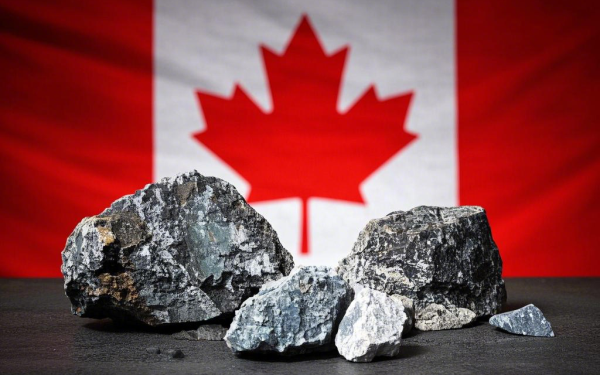
Amid escalating global trade tensions and a fracturing geopolitical landscape, Canada is making a high-stakes play to secure its place in the new world order—not with military might, but with its vast underground wealth.
At the Prospectors & Developers Association of Canada (PDAC) 2026 convention in Toronto, the world’s premier mining event, Canadian Energy and Natural Resources Minister Tim Hodgson issued a fiery declaration: Canada is leveraging its critical minerals as strategic leverage to build a sovereign, secure supply chain, backed by a $12.1 billion infusion from allied nations.
“This is our moment to shine,” Hodgson told BNN Bloomberg on the convention floor.
The minister framed the initiative not merely as an economic opportunity, but as a matter of national security. In a global market where processing is heavily dominated by players like China, Hodgson asserted that Canada must never find itself in a position of dependency.
“Critical minerals are the strategic card that differentiates us from the rest of the world,” he said. “Secure, critical mineral supply chains are national security. It is sovereignty, and we have that.”
The cornerstone of the strategy is keeping the value chain at home. Hodgson emphasized that Canada is reinvesting in idle smelters and expanding infrastructure at a pace not seen since World War II. The government is partnering with private enterprises to restart copper, zinc, and nickel smelters, utilizing homegrown technology to process the minerals the world desperately needs. Specific support is already flowing to projects like the Crawford Nickel Project in Timmins, Ontario, and Foran Mining’s copper project in Saskatchewan.
The financial firepower behind this vision comes from “The Alliance,” a critical minerals partnership initiated last year by Prime Minister Mark Carney. Designed to wean allied nations off risky foreign suppliers, The Alliance has now secured commitments from 12 partner countries, channeling a total of approximately $18.5 billion into Canada’s mineral sector. Of that, $12.1 billion is directly earmarked for mining and processing projects within Canadian borders.
Hodgson described the investment as a tool to “put cards in our hand,” enabling work on refining heavy rare earth metals and other high-value processes that will differentiate Canada on the global stage.
To ensure processing capacity takes root, Ottawa is deploying a suite of financial tools, including the $1.5 billion First and Last Mile Fund (FLMF) and the $2 billion Critical Minerals Sovereign Fund, to build essential infrastructure.
The urgency was echoed at the provincial level. Ontario Premier Doug Ford used the PDAC platform to announce an accelerated timeline for road construction into the Ring of Fire, a massive but undeveloped critical minerals region in the province’s north. Construction is slated to begin in June, with completion by 2031—years ahead of schedule.
“With President Trump’s tariffs causing so much uncertainty, we don’t have a second to waste,” Ford stated.
Meanwhile, the federal government is broadening its international outreach. A joint statement from Prime Minister Carney and Indian Prime Minister Narendra Modi underscored a new commitment to deepen resource partnerships, highlighted by a signed memorandum of understanding on critical minerals value chains. An Indian delegation is also present at the PDAC convention.
While the political and industry momentum at PDAC was palpable, a sobering assessment from RBC Capital Markets released just before the convention served as a reality check.
The report warned that Canada’s ambitions face significant hurdles, primarily a chronic shortage of “patient” risk capital. It noted a “hollowing out” of the Canadian mining industry between 2005 and 2012, when over $119 billion in base metals and steel assets—including industry giants Inco, Alcan, and Falconbridge—were transferred to foreign ownership, leaving a void in national champions.
RBC argued that the federal government’s $2 billion Critical Minerals Sovereign Fund is insufficient in its current form and needs to be scaled up dramatically to deploy sovereign capital across the full value chain. It also highlighted a massive infrastructure funding gap, noting that the Ring of Fire alone requires an estimated $2.4 billion in road and transmission investment to move forward.
“The industry faces real challenges, serious ones, geopolitical risk,” Don Lindsay, former CEO of Teck Resources Ltd., cautioned in a keynote address. “The world is more fragmented than it has been in decades. We’re seeing supply chain vulnerability… We’re exposed to geopolitical risk like we’ve never been before.”
To overcome these obstacles, RBC recommended a multi-pronged approach: clustering critical minerals processing, attracting major foreign miners, and cautiously forging closer ties with North American supply chains. A significant step in this direction is the proposed merger between London-based Anglo American PLC and Vancouver’s Teck Resources, billed as a “merger of equals” aimed at creating a domestic critical minerals powerhouse.
As PDAC 2026 unfolds, the message from Ottawa and industry leaders is clear: Canada is determined to transform itself from a mere extractor of resources to a dominant processor. But with significant capital shortfalls and intense global competition, the question remains whether this ambitious “trump card” will be enough to win the hand.