American Tungsten Corp. (TSXV: TUNG, OTCQB: DEMRF)
Building America’s Defense Critical Metals Supply
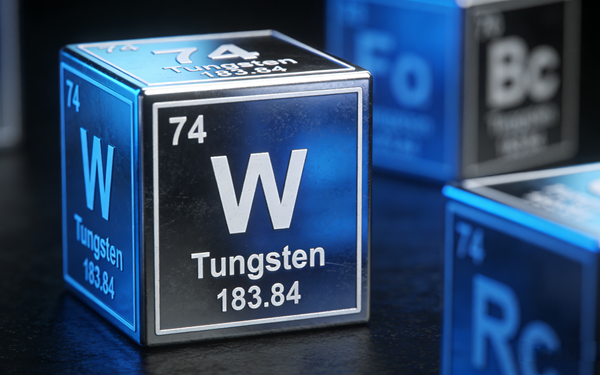
A recent report by S&P has revealed the truth behind the insufficient weapons production capacity of the United States: a lack of critical metals such as tungsten, antimony, gallium, and germanium. Meanwhile, Canadian think tank Critical Minerals Institute pointed out that once the U.S. runs out of these critical metals, it will be unable to manufacture new weapons. Tungsten, antimony, gallium, and germanium are all important metals in the military industry, with tungsten being particularly critical—named as the “war metal.”
By late March 2026, the benchmark price of ammonium paratungstate (APT) in the European market had surged to $2,250 per metric ton unit, accumulating a staggering 557% increase over the past year—far outpacing the performance of gold, copper, and crude oil. The root cause of this unprecedented price surge lies in a double resonance of supply contraction and surging military demand.
Supply side: China’s export restrictions trigger a global supply chain earthquake
China holds an absolutely dominant position in the global tungsten supply chain—accounting for 79% of global production and possessing the world’s largest tungsten reserves. In February 2025, China implemented export controls on tungsten-related items. This, combined with three consecutive years of reduced mining quotas (with the first batch of quotas in 2025 down by 4,000 metric tons year-on-year) and stricter environmental inspections, has led to a sudden tightening of global tungsten supply.
Data shows that in the first two months of 2026, China’s tungsten product exports fell by 27.6% year-on-year, with APT exports at one point dropping to zero. More crucially, domestic demand in China is also rising—the penetration rate of tungsten wire diamond wire mesh in the photovoltaic sector has exceeded 60%, and tungsten hexafluoride (WF₆), used in semiconductor manufacturing, has become a new growth driver. This means that even without export restrictions, tungsten resources flowing from China to the international market are naturally shrinking.
Demand side: War as a “metal shredder”
The Iran war that broke out in March 2026 has laid bare the military attributes of tungsten. George Heppel, an analyst at BMO Capital Markets, stated bluntly: “The Iran war is a sharp reminder of how metal-intensive 21st-century warfare is. Tens of thousands of drones and missiles—tungsten plays a pivotal role in them.”
According to estimates by Project Blue, military-related tungsten consumption is projected to grow by 12% in 2026, covering sectors such as helicopters, fighter jets, and ammunition. Unlike the civilian sector, military procurement is highly price-insensitive and can always offer the highest bid when supply chains are strained—further squeezing available resources for civilian markets.
Supply-demand gap hard to fill quickly: at least two years of “pain period”
Alternative supplies in the West are beginning to emerge, but they cannot meet immediate needs. Kazakhstan’s Boguty mine began production in 2025, and Cove Capital signed a $1.1 billion agreement to develop the North Katpar and Verkhny Kayrakt deposits in the country. The U.S. has also supported feasibility studies for projects like Pilot Mountain in Nevada through Defense Production Act funding.
However, it typically takes three to five years for a tungsten mine to go from exploration to stable production. David Argyle, co-founder of Arlington Innovation Partners, noted that new Western supply would take about two years to materialize—provided investors believe high prices are sustainable. Until then, the market will have to endure the agony of “having money but no supply.”
Investment implications: The revaluation of strategic metals is just beginning
The current surge in tungsten prices is by no means an ordinary commodity cycle; it represents a triple overlay of “geopolitical premium + supply chain restructuring premium + military consumption premium.” For investors, this means:
First, pricing logic has changed. Tungsten is no longer priced purely by supply and demand—it now carries a strategic premium tied to national security. When a metal becomes an “irreplaceable” component in missile armor-piercing rounds and semiconductor manufacturing, its price center will systematically shift upward.
Second, focus on non-China production capacity and the recycling sector. Tungsten mining projects in countries such as Kazakhstan, South Korea, and Portugal are becoming the focus of Western capital. Meanwhile, the economic viability of recycling cemented carbide scrap has improved significantly, creating opportunities for value reassessment of related technology companies.
Third, be alert to cost transmission in civilian sectors. The sharp rise in tungsten prices has begun to propagate downstream—South Korean semiconductor material manufacturers have already raised tungsten hexafluoride prices by 70% to 90%. Cost pressures are building in sectors such as high-end cutting tools, photovoltaic wafer cutting, and aerospace.
A tungsten supply crisis—ignited by conflict in the Middle East and fueled by China-U.S. competition—is reshaping the global critical minerals supply-demand landscape. As Lewis Black, CEO of Almonty Industries, put it: “We’ve never experienced a situation where the market determines the price, so we really don’t know where the price will eventually settle.” What is certain is that the “golden age” of strategic metals has arrived—and tungsten is standing at the center stage.