
SLAM Exploration Ltd. (TSXV: SXL)
‘Exploring for critical elements and precious metals in New Brunswick, Canada.’
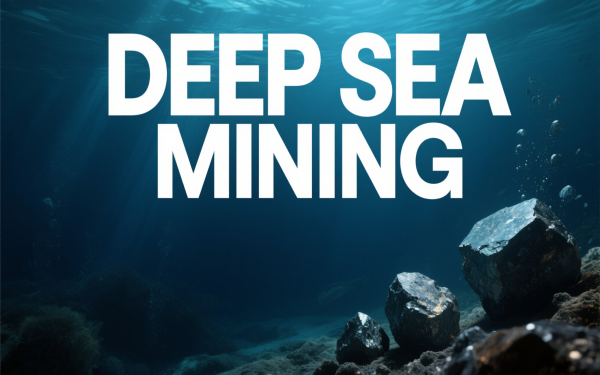
A little-known deep-sea explorer is backdoor-listing on Nasdaq with a former Rio Tinto CEO at the helm, over $230 million in fresh capital, and billions of tonnes of polymetallic nodules on the Pacific seabed. The question: is this America’s strategic answer to critical mineral dependency, or a high-stakes technological gamble?
On April 8, American Ocean Minerals Corp. (AOMC) and Nasdaq-listed Odyssey Marine Exploration (OMEX) announced a definitive merger agreement. The reverse takeover values the combined entity at roughly $1 billion. The company will retain the AOMC name and is expected to trade on Nasdaq under the ticker “AOMC”.
This is no ordinary backdoor listing. Ahead of the merger, AOMC raised more than $230 million in equity financing, including $150 million from an institutional private placement and $75 million from a pre-public round completed in February. The combined company is expected to hold approximately $175 million in cash at closing.
The management team reads like a blue-chip roster. Chairman is Tom Albanese, former CEO of Rio Tinto. CEO Mark Justh brings capital markets credentials from JPMorgan Chase and Goldman Sachs. Founding investor and special adviser Mike Rowe is a well-known US media figure and advocate for reindustrialization.
Odyssey Marine brings over three decades of offshore exploration experience, with assets including polymetallic nodules and phosphate projects in Mexico and the Pacific, as well as hands-on expertise in deep-sea operations, environmental baseline studies, and regulatory applications.
The prize lies in the polymetallic nodules scattered across the Pacific floor – rich in nickel, cobalt, copper, manganese and rare earths, all critical for EV batteries and defence supply chains. AOMC has built a two-track portfolio:
Together, the two tracks cover over 500,000 square kilometres, making the merged AOMC the largest US-controlled deep-sea critical minerals platform.
The timing is notable. President Trump has signed an executive order to fast-track offshore mineral exploration, aiming to reduce US reliance on Chinese-dominated rare earth supply chains. Rather than wait for the slow-moving International Seabed Authority (ISA), AOMC has chosen a “sovereign pathway” under US domestic law and Cook Islands national legislation – a move that aligns neatly with Washington’s push for friend-shoring and domestic extraction.
“AOMC will be positioned to be a reliable, long-term supplier for American re-industrialization,” said chairman Tom Albanese.
From a capital markets perspective, the merger offers a compelling narrative: US critical mineral independence, a deep-sea blue ocean, a star-studded management team, and ample cash. If the company can successfully advance environmental studies and pilot harvesting, and reach commercialization by the late 2020s, it could become a strategic asset for North America’s EV and defence supply chains.
Yet the challenges are formidable. Environmental groups warn that deep-sea mining could destroy fragile ecosystems; the EU and several nations have called for a moratorium. On the technical front, commercial‑scale nodule collection and lift systems remain unproven. Regulatorily, the DSHMRA has never issued a commercial mining permit since its enactment in the 1980s. And international competition is heating up, with China, Russia and others also actively staking claims.
For AOMC, the $1 billion valuation is only the starting line. The real test – and the ultimate proof of whether it becomes the first true deep‑sea mining listed company – will come in the next few years: completing environmental research, securing permits, and actually bringing a ship loaded with nodules to shore.