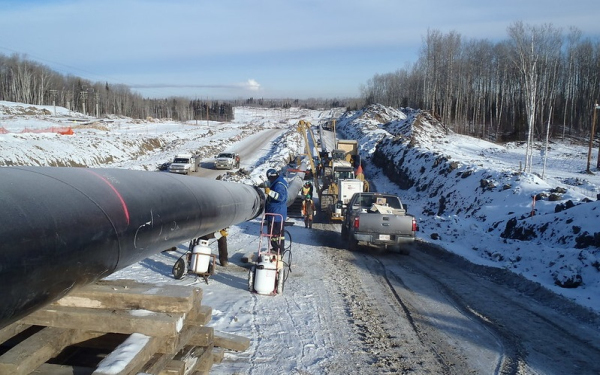
President Donald Trump on Thursday signed an executive order authorizing a proposed cross-border pipeline that would carry Canadian crude from the U.S.-Canada border to Wyoming. The project, a joint proposal from Canadian pipeline company South Bow and U.S.-based Bridger Pipeline, could boost Canada’s crude exports to the United States by more than 12%.
“It’s a huge deal in terms of long-term energy dominance and energy security,” White House staff secretary Will Scharf said as Trump put pen to paper.
“Slightly different from the last administration,” Trump told the room, drawing laughs from the politicians standing behind him. “They wouldn’t sign a pipeline deal and we have pipelines going up. And by the way, they’re way underground. They’re not a problem. Nobody even knows they’re there.”
The move, however, stands in stark contrast to Trump’s own words just over a year ago. In January 2025, Trump told the World Economic Forum that the U.S. does not need Canada’s oil and gas, boasting that “we have more than anybody.” He also suggested at the time that Canada should become the 51st state.
The numbers tell a different story. Canada already supplies more crude to the U.S. than any other nation. In 2025 alone, Canada exported 1.64 billion barrels of crude oil and related products to its southern neighbour. The new pipeline would add another 12% to that flow.
A spokesperson for Canadian Energy Minister Tim Hodgson said the government is aware of the order and “remains focused on strengthening Canada’s position as an energy superpower.” South Bow, for its part, did not directly mention the pipeline Trump authorized, saying only that it continues to evaluate a separate project that would move crude to the U.S. border.
Not everyone in Canada sees the pipeline as a victory.
“I think it’s time to turn our focus away from the United States,” said Roger McKnight, a petroleum analyst at En-Pro International. “Get the oil out of the country from the West Coast, go up north, or go east, but certainly the south is not a friendly place to be right now.”
McKnight noted that four previous U.S. presidential administrations had floated similar cross-border pipeline proposals only to abandon them. “We don’t know what’s going to happen with the next president,” he said. “Make up your mind United States, and make up your mind Canada.”
The new pipeline would effectively revive parts of the Keystone XL project, which former president Joe Biden cancelled early in his term. While the route on the U.S. side differs from the original Keystone XL, the project will use some of the pipe already laid on the Canadian side. South Bow itself was spun off from TC Energy — the original Keystone XL proponent — in 2024.
U.S. and Canadian officials discussed the proposal as early as March at an energy conference in Houston. Hodgson said at the time that Canada was pitching the pipeline as a way to help the U.S. achieve energy security, particularly as the Iran war disrupts global crude supplies and pushes up prices.
On the same day Trump signed the order, gasoline prices in Vancouver hit C$2.17 per litre, far above the national average of C$1.82. Trump told reporters Thursday that once the Iran war ends, prices will “drop like a rock.”
But hopes for a quick end to the conflict are fading. Talks between the U.S. and Iran have reportedly broken down. “The breakdown of talks between the U.S. and Iran, along with President Trump reportedly rejecting Iran’s proposal for a reopening of the Strait of Hormuz, has the market losing hope for any quick resumption in oil flows,” ING Bank strategists Warren Patterson and Ewa Manthey wrote in a research note.
One day Trump declares the U.S. doesn’t need Canadian oil. The next, he authorizes a new pipeline to bring more of it across the border. The contradiction may reveal a simple truth: energy security often trumps campaign-style rhetoric — and Canada, for all its talk of diversification, remains tethered to an unpredictable southern neighbor.