
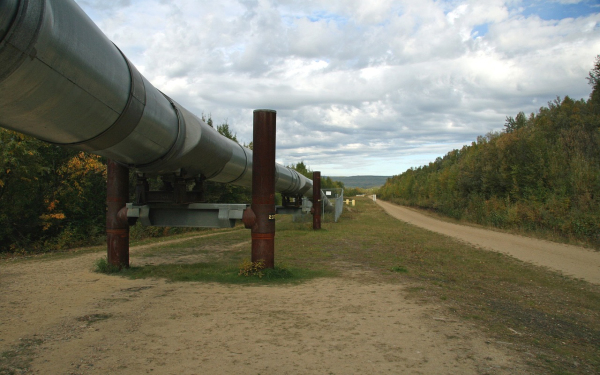
Canada’s Trans Mountain pipeline has operated at full capacity for the first time since its expansion was completed, with its total throughput reaching 890,000 barrels per day. Citing a senior executive at Trans Mountain Corp., Reuters reported that current market demand has outstripped the pipeline’s maximum capacity, triggering apportionment — a scenario never seen before following the expansion launch.
Stretching from Alberta’s oil sands to marine terminals on British Columbia’s Pacific coast, the pipeline has witnessed a dramatic turnaround in utilisation rates over the past two years. It ran at roughly 84% capacity last summer and 78% in June last year, before finally operating at full tilt this month. Supply disruptions stemming from Middle East tensions and broader global energy market uncertainty are the key drivers behind the surging appetite for Canadian crude. Faced with unreliable supplies from Gulf producers, Asian refiners have turned to Canadian heavy oil as a stable alternative, pushing purchasing volumes sharply higher.
Asia stands as one of Canada’s most vital overseas markets for crude oil. China emerged as the top buyer of Canadian crude last year, importing more than 200,000 barrels per day on average. The robust demand has led industry insiders to forecast that existing pipeline capacity will soon fall short again.
To address the tightening supply, Trans Mountain launched a new open season for pipeline capacity in late May, aiming to secure commitments for an additional 72,000 barrels per day of throughput capacity. The company will also add another 90,000 barrels per day of capacity by deploying anti-drag agents. Mark Maki, Chief Executive Officer of Trans Mountain, noted that expansion efforts will continue. The pipeline is projected to lift its daily capacity to 1.2 million barrels by 2029. Additionally, a series of optimisation projects, including the use of drag-reducing chemicals and new pumping stations, will add 300,000 barrels per day by the end of 2028, translating to a roughly 34% increase in overall capacity.
Alberta is also proposing a second crude pipeline to deliver oil to British Columbia’s coast, designed to carry 1 million barrels per day. However, the project faces fierce opposition from environmental groups, casting uncertainty over its prospects. The British Columbia government now supports capacity optimisation for the existing Trans Mountain system and has approved waterway dredging to facilitate tanker loading at local terminals, yet it rejects plans for a new pipeline along the province’s northwest coast.
The Canadian federal government previously planned to privatise the federally owned Trans Mountain pipeline, but has put such plans on hold for the time being. Executives explained that tight capacity and ongoing expansion initiatives make it an inopportune moment for a sale.
Ottawa and Alberta signed a memorandum of understanding to advance new pipeline projects and expand Pacific export access. Still, a proposed northern route has encountered staunch resistance from Indigenous communities, who refuse to accept the inherent spill risks. Federal authorities now lean toward exploring alternative routes in southern British Columbia, which are deemed more feasible.
Crude output in Alberta is on track to surpass last year’s record of 5.3 million barrels per day. Combined with shifting global energy trade patterns, Canada is ramping up investments in Pacific export infrastructure. Market observers believe supply risks in the Middle East will persist for the foreseeable future, underpinning long-term demand for Canadian crude in Asia. As a result, capacity upgrades and expansion work at the Trans Mountain pipeline will forge ahead steadily.