SLAM Exploration Ltd. (TSXV: SXL)
‘Exploring for critical elements and precious metals in New Brunswick, Canada.’
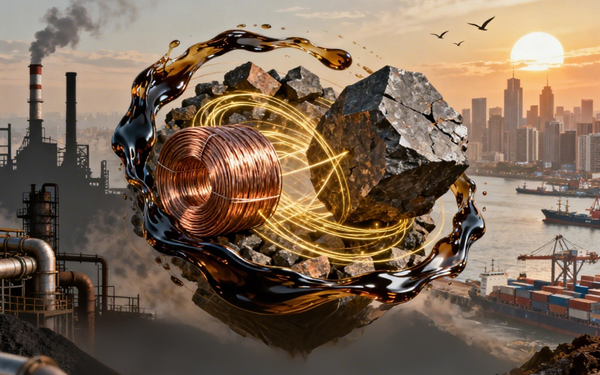
A commodity supercycle is not an ordinary bull market. It is a wave that builds momentum over decades, lifting prices across oil, gold, copper, and wheat for 10 to 25 years. Over the past 120 years, the world has ridden four such waves, ignited by American industrialization, post-war reconstruction, Japan’s rise, and China’s urbanization. Now, a fifth supercycle is taking shape, and for the first time, it is not powered by a single economic transformation but by four forces converging at once: the energy transition, a global arms build-up, the explosive growth of artificial intelligence, and the gradual unwinding of dollar dominance.
This rare alignment is thrusting copper onto center stage. Solar farms consume several times more copper per unit of capacity than gas-fired plants; an electric vehicle carries multiples of the copper found in a combustion-engine car. At the same time, building a new mine from discovery to production takes 10 to 15 years, ensuring that supply cannot sprint to meet surging demand. The structural deficit already visible on the horizon has turned the metal into the supercycle’s most strategic asset—and placed Freeport-McMoRan (NYSE: FCX), the world’s largest publicly traded copper producer, under an unusually bright spotlight.
So what exactly anchors Freeport-McMoRan’s value in this new era? The answer lies not in a simple bet on rising prices, but in three rare and reinforcing advantages that few of its peers can match.
The first is a concrete, near-term production ramp. After a temporary setback in Indonesia, Freeport is entering a clear growth window. Management has guided copper sales of 3.1 billion pounds in 2026, rising to 3.8 billion in 2027 and exceeding 4.1 billion by 2028—a more than 30% increase in just two years. In a business where new supply is measured in decades, the ability to deliver incremental volumes on this scale puts Freeport at the front of the pricing queue.
The second anchor is a low-cost “second mine” hidden in its own waste piles. Through an aggressive leaching initiative, the company is recovering copper from stockpiled material that was previously uneconomical to process. Management targets 400 million pounds per year from leaching by 2027, scaling to 800 million pounds by 2030. This is the equivalent of bringing a mid-sized mine online without the permitting battles, community friction, or billion-dollar construction budgets. In a supercycle, it also magnifies profit margins—the marginal cost of leaching is a fraction of traditional mining, turning price gains directly into free cash flow.
The third anchor is a strategic American footprint tied to the electrification of everything. Data centers alone could consume 8% of U.S. electricity by 2030, according to Goldman Sachs, and every additional gigawatt of solar, every mile of upgraded grid, and every charging station depends on copper. Freeport plans to expand its U.S. production from 1.2 billion pounds to 2 billion pounds by the end of this decade, leaning on both brownfield expansions and its leaching technology. In a world where supply-chain security is becoming a national priority, that domestic base carries a premium that balance sheets alone cannot capture.
Just as important is what Freeport does not carry: the execution risk embedded in other “supercycle” trades. Rare-earth hopefuls like MP Materials must still navigate the delicate vertical leap from mining to magnet manufacturing, coping with technology-transfer hurdles and concentrated customer relationships. Freeport’s value proposition, by contrast, is directly wired into the copper price. The transmission from output growth and cost discipline to shareholder return is simpler, more transparent, and far less prone to derailment.
Put simply, in a supercycle defined by rigid supply and accelerating demand, the scarcest commodities are not just the metals beneath the ground. They are the permits, the proven technology, and the political safety of geography that allow a miner to turn rock into revenue with confidence. Freeport-McMoRan holds all three. As the energy transition, the AI buildout, and a rewiring of the global monetary system all cry out for more copper, the companies that can deliver it with certainty—not just promise it—will be the true anchors of value. For now, Freeport looks like one of the few names that can.