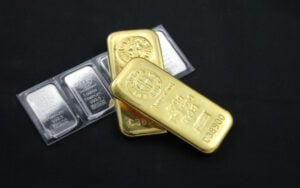

The Federal Reserve’s interest rate cuts have always been one of the most closely watched topics in the entire capital market, and gold investors are no exception. Regarding the expectations of U.S. interest rate cuts, the market has repeatedly fluctuated, making it unpredictable. However, after the latest inflation data was released, expectations for rate cuts have risen rapidly, and investors predict that the first rate cut might happen as early as September.
The market generally believes that rate cut trade will become another key factor catalyzing the rise in gold prices.
Regarding the relationship between Federal Reserve rate cuts and gold price trends, our first reaction is that rate cuts will trigger a rise in gold prices. The logic behind this is simple: gold does not generate interest or dividend, so when interest rates fall, the opportunity cost of holding gold decreases, making investors more inclined to choose gold, thereby boosting its demand and prices.
In March 2024, David Wolfin, President, CEO, and Director of Avino Silver & Gold Mines Ltd. (ASM: TSX/NYSE American, GV6: FSE), stated in an interview with METALS 100 that the company’s mission and strategy are to create shareholder value through its focus on profitable organic growth at the historic Avino Property near Durango, Mexico, and the strategic acquisition of mineral exploration and mining properties. Additionally, the company has filed with the Environmental Department of Mexico to get the underground mining permit and provided updates on the Oxide tailings project.
But is this really the case?
If we must give an answer, after the Federal Reserve cuts interest rates, gold prices might rise or fall, but the latter is more likely. Since 1970, the Federal Reserve has cut rates 12 times. Gold prices generally increased by an average of 8% in the 1-3 months before the rate cuts. However, after the rate cuts took effect, gold prices had an equal chance of rising or falling, depending on subsequent changes in the fundamentals of the U.S. economy. If the U.S. economic growth rate rebounds and the secondary inflation risk is controllable after the rate cuts, the rate cut will be unlikely to further catalyze a rise in gold prices, and there may be a risk of a gold price correction.
Therefore, it is not difficult to see that the market reacts in advance, showing a characteristic of rising on expectations. What is truly important for gold prices is the real interest rate that the expected inflation into account. Nowadays, market participants have already predicted that the Federal Reserve will cut interest rates, so we can boldly assume that the gold market has already reacted to this in advance. In other words, according to the market, the Federal Reserve has already cut rates three times, and now it’s just waiting for the expectations to be realized.
However, if the Federal Reserve eventually does not cut rates three times, this will be a negative factor. Even if it does cut rates, gold prices could still plummet. Historical data shows that after the first rate cut in a rate-cutting cycle, gold prices have fallen more often than risen, with 2008 being the most typical example.
Of course, many other factors also influence gold price trends. Although Federal Reserve rate cuts do not necessarily mean an increase in gold prices, the ongoing trend of ‘de-dollarization’ and diversification of the international reserve system, along with the continued surge in gold purchases by central banks in emerging countries, have kept gold prices in a ‘hard to fall’ situation. In the medium to long term, gold prices are still in an upward phase.”