
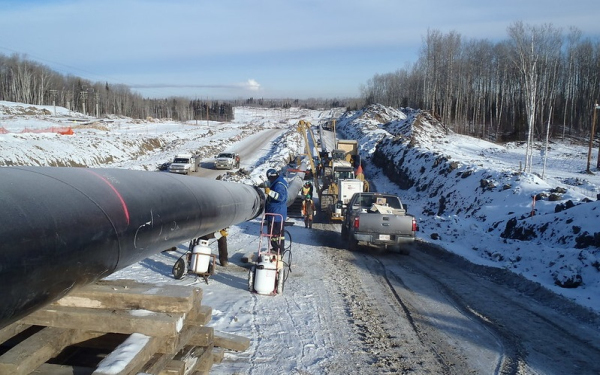
To address Canada’s rising oil production and the increasing transportation demand from U.S. refining hubs, Canadian pipeline giant Enbridge (TSX: ENB) is considering boosting its crude oil shipping capacity to the U.S. by an additional 200,000 barrels per day (bpd) through a new pipeline project. Partnering with Energy Transfer, Enbridge has launched an open bid process to gauge market interest in the proposed Southern Illinois Connector project.
This project involves upgrading existing systems and constructing a new pipeline segment connecting Wood River and the Patoka oil hub in Illinois. The new line will integrate with Enbridge’s Mainline system, facilitating the transport of oil sands crude from Alberta to the U.S. Midwest and Gulf Coast markets. According to Enbridge, the proposal is designed to meet industry demand for expanded transportation capacity from Illinois’ Flanagan hub to the Gulf Coast.
The open bid process will run until July 18, 2025.
Enbridge currently operates one of North America’s largest crude oil transportation networks, with its Mainline system moving over 3 million barrels of crude and liquids daily. The company plays a pivotal role in the region’s energy infrastructure, handling:
The pipeline expansion comes at a strategic moment for Canadian producers, who are increasing output from Alberta’s oil sands. This week, S&P Global Commodity Insights released a 10-year outlook predicting that, despite current low oil prices, Canadian oil sands production will hit a record 3.5 million barrels per day (bpd) in 2025, with output expected to climb to 3.9 million bpd by 2030. Optimizations in existing projects and efficiency improvements are cited as the primary drivers of this growth.
Furthermore, the International Energy Agency (IEA) forecasts an overall increase of 680,000 bpd in Canadian oil production by the end of the decade, driven primarily by incremental improvements at oil sands facilities.
Amid Enbridge’s new pipeline plans, Canada’s major oil-producing province, Alberta, is simultaneously advancing internal transportation projects. Premier Danielle Smith recently announced that private companies are expected to submit proposals for a new pipeline to British Columbia’s northwest coast within weeks. This pipeline, with a proposed capacity of 1 million bpd, aims to export Canadian oil sands crude to global markets.
The push for expanded transportation comes against the backdrop of strained Canada-U.S. relations during President Trump’s tenure, which had previously led to the widespread rejection of Alberta’s export pipeline proposals. Policymakers at both federal and provincial levels now recognize the strategic error in scrapping these projects over the past decade.
Currently, Canada’s west coast oil exports rely solely on the expanded Trans Mountain pipeline, which ships Alberta’s crude to offshore markets. With Canada accelerating the approval of major energy projects, Alberta is seeking to reopen constructive dialogue with the federal government, following commitments by Canadian Prime Minister Mark Carney to expedite energy initiatives and position Canada as a global energy powerhouse.
By collaborating with provinces and private companies, Canada aims to strengthen its energy infrastructure and diversify its export markets, reducing dependency on the United States.