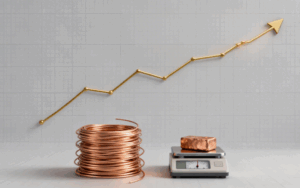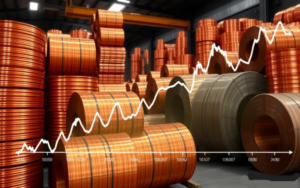
Copper’s 2026 trajectory has turned into a white-knuckle ride. After a blistering start that saw prices smash through record highs above $14,500 per ton, the rally has been snuffed out by escalating conflict in the Middle East. As of this week, the industrial metal has erased all its year-to-date gains and is now trading 2.5% lower than where it started the year.
While the market debates whether the $12,000 level represents a buying opportunity, Goldman Sachs Group Inc. has doused bullish sentiment with a cold dose of reality. In a note released this week, analysts led by Aurelia Waltham delivered a stark warning: if the war drags on and continues to choke off the Strait of Hormuz, copper faces significant further downside.
But why is a bank typically fixated on supply-and-demand fundamentals now pinning copper’s fate on geopolitics in the Middle East? The answer lies in a two-part chain reaction.
Goldman’s concern is not abstract. Since the onset of U.S. and Israeli strikes on Iran, the Strait of Hormuz—the narrow seaway through which roughly one-fifth of the world’s oil trade passes—is effectively disrupted. While copper itself is not mined in the Middle East, its lifeblood is global industrial demand. And nothing chokes industrial demand faster than the stagflationary vise of high energy prices.
Waltham and her team note that if the disruption of strait flows lasts longer than Goldman’s base-case scenario, energy prices will stay elevated for an extended period. This triggers two immediate consequences: a further slowdown in global economic growth and a sharp deterioration in the demand outlook for industrial metals. Copper, known colloquially as “Dr. Copper” for its ability to diagnose the health of the global economy, is hypersensitive to this dynamic. In just the past few weeks, the mere anticipation of sustained oil-price pressure has already driven copper down roughly 7% since the conflict began, pushing prices back toward the $12,000 handle.
Goldman’s bearish tilt goes beyond geopolitical fear. The core of the bank’s argument is that copper’s current price lacks fundamental support.
The math is straightforward. Even after the recent pullback, copper is hovering around $12,300 a ton, and the average price realized so far in 2026 sits near $12,850. That figure is well above Goldman’s estimated fair value of approximately $11,100 per ton. “The copper price is not being supported at the current level by fundamentals,” Waltham wrote bluntly. “This makes it vulnerable to another move lower should the economic outlook deteriorate and investors de-risk.”
In essence, Goldman argues that the current market price is inflated by a “strategic stockpiling premium” or structural tightness outside of the United States. But against the hard reality of softening global aggregate demand, that premium looks increasingly fragile.
Armed with this logic, Goldman Sachs has trimmed its base-case forecast for copper in 2026 to $12,650 per ton, down from $12,850 previously. This revised outlook is contingent on the assumption that the Strait of Hormuz begins to reopen from mid-April.
However, the real risk resides in what the bank terms a “severely adverse” scenario. If the blockade becomes protracted, Goldman estimates it could cap copper demand by 0.5% to 1%. While that percentage seems small on paper, in the world of marginal commodity pricing, it is often the difference between a soft patch and a crash. A separate analysis from Bloomberg Intelligence was even more pessimistic, suggesting that a drawn-out war could drag copper prices below the $10,000 per ton threshold.
While Goldman’s analysts have not explicitly adopted that ultra-bearish target, the Waltham-led team stressed that as long as the Iran situation remains unresolved and the demand narrative stays weak, further downward moves cannot be ruled out.
Goldman’s warning signals a precarious state of affairs for copper. The metal’s current sideways consolidation is not built on solid ground. Should the geopolitical temperature fail to cool, the copper market will face more than just a technical correction—it will undergo a “de-bubbling” process driven by macroeconomic deterioration. As Dr. Copper stares down the turmoil in the Strait of Hormuz, a valuation reckoning may only be a matter of time.